Advent I | Peace

I was eight or nine years old when I first visited New York City. It was probably 1984. My mom had just moved to the East Coast and was eager to introduce me to the big city. I was visiting for Christmas.

There’s a lot I don’t remember about that trip, but I do remember it being bitter cold and snowy, and that my throat had become raw from a hacking cough. My mom wasn’t yet fluent with city navigation, but we were trying to get to Broadway on a bus to see a meteoric new musical called Cats. After becoming hopelessly turned around, we reluctantly approached a woman at a bus stop to ask for help. This was NYC in the 80s. It was a very different place then. The woman was unexpectedly kind and helpful. She directed us to the exact stop and gave us all the details we’d need to get to our destination. The MTA bus soon arrived, and we boarded.

Entering the warmth of the crowded bus, we heard a small child crying in the back. My mom leaned over to me and said something like, “You know, people always talk about how New Yorkers are so rude, but most of them are really nice…”

As the words departed her mouth, a woman in the back of the bus shrieked at the crying child, “Shut the hell up you stupid little brat!”

The entire bus fell into an uneasy silence. You know the type. And we rumbled tensely down a snowy New York City street together. You cannot transit long through this world without being jarred from illusions of peace; jarred awake into the very normativeness of its absence. Pax in absentia.

Of course we could resign ourselves to this. Recalibrate our expectations and feel justified in doing so. But then Advent comes along and ruins all of that! We find ourselves singing songs under our breath about peace on earth. If we don’t watch out, we get ourselves suckered in. 

Lately I’ve been thinking about the pangs of Advent and how it inconsiderately commands attention to all our most elusive longings. Advent is so troublesome.

For instance, two thousand years ago some shepherds were just minding their own business, when an incommodious choir of angels showed up singing,

Glory to God in the highest heaven,
    and on earth peace to those on whom his favor rests.

Of course, they could have said “not interested”—the way you rebuff a flyer on the streets—but, against their better judgement, they said, “let’s go see.” And they did. 

So here we are, two millennia later, still trying to make heads or tails of what they saw. The fractures of our world finger out into every relationship, every arena, every crawlspace of our souls. It’s just everywhere.

The Jewish idea of peace is far more textured than that of a placid mental state or even a lack of clashing. It is shalom; wholeness, rightness, things as they ought to be. If you asked some Jews today about their purpose in life, they may quote the Hebrew phrase tikkun olam: “repair the world.” That is another way of admitting that our world is in such need of repair. What a tall order! Of course Jesus gave that his own spin, “Blessed are the peacemakers, for they will be called children of God.” Children of God are, it would follow, to bring shalom to this forlorn world or die trying—being, more often than not, the latter, whether by full or fractional degrees.  

Being a peace-welcomer, let alone peacemaker, resembles Charlie Brown’s hapless placekicking career. Somehow Lucy always convinces him she’s not going to yank the ball away sending Charlie thudding onto his back. But she always does. Do we dare lift up our hearts to peace? Aren’t we bound to go thudding onto our backs in a world like ours; a world where St. Nick himself could end up in a physical altercation over doctrinal disagreements? If St. Nick can’t stay off the naughty list…

And what did those shepherds find in Bethlehem? A crying baby. Not unlike our short-fused friend on the bus. Then they went around telling people he was their only hope. (Ah, hope. I’m coming for you next.) I would wager their own expectations of this child were woefully misshapen. But what did they know?

A few days later, Mary and Joseph presented him at the temple. An aged man named Simeon approached them. He too began to sing:

Sovereign Lord, as you have promised,
    you may now dismiss your servant in peace.
For my eyes have seen your salvation,
    which you have prepared in the sight of all nations:
a light for revelation to the Gentiles,
    and the glory of your people Israel.

It had a good ring . . . until he offered some parting remarks (no longer in song):

This child is destined to cause the falling and rising of many in Israel, and to be a sign that will be spoken against, so that the thoughts of many hearts will be revealed. And a sword will pierce your own soul too.

Simeon, you should have stopped while you were ahead! Who knew Advent was such a yo-yo? It always has been. We’ve all harbored questions about that piercing sensation. No real sword pierced Mary’s soul. Only anguish and grief and dismay at what this world was capable of. Simeon understood how piercing these things are.

So did Jesus. “Do not suppose that I have come to bring peace to the earth,” he said. “I did not come to bring peace, but a sword.” Jesus wasn’t referring to an actual sword either, but to strife and enmity. “A man’s enemies will be the members of his own household.” (Ironically, he does seem to sing this part, but I can only imagine it in minor keys.)  What a weird concert this becomes.

We recall an earlier verse, delivered by the weeping prophet Jeremiah: “The prophets and priests alike both practice deceit,” he laments,

They have dressed the wound of my people lightly,    Saying, “Peace, peace,” when there is no peace.

The peculiar peace of Advent is no light dressing of wounds. In fact, the peace of Advent is an indictment of such superficialities. Advent peace must plunge painfully deep, and we can feel it. It plunges like a sword. The sword becomes a scalpel. How else can we explain the fact that we’ve never seen stanzas like this, from the beloved and familiar hymn “It Came Upon a Midnight Clear”?

Above its sad and lowly plains,
   They bend on hov’ring wing,
And ever o’er its Babel sounds
   The blessed angels sing.

And man, at war with man, hears not
    The love-song which they bring;
Oh, hush the noise, ye men of strife
    And hear the angels sing.

We’re hesitant to sing such lines. It feels like bad manners. But they were penned by pastor, author, abolitionist, and activist Edmund Sears during a period of great turmoil in his life.

The year was 1849, and he was coping with a painful ministry failure and the grief of engulfing social injustice . After 7 difficult years pastoring a large congregation in Lancaster, MA, he underwent a nervous breakdown. More than that, his society was roiled by the evils of slavery which pained him excruciatingly. The controversy in those days was over the Fugitive Slave Act. By 1850, it would become required of authorities in non-slave states to capture escaped slaves and return them to their bondage. Awful days. Sears was forced into a time of retreat, and sought refuge as a part-time pastor in a previously-held pulpit of Wayland, MA. One can read his travail in the lyric,

And ye, beneath life’s crushing load,
   Whose forms are bending low,
Who toil along the climbing way
   With painful steps and slow

The hymn was Sears’ own way of bringing Advent peace to bear upon the sad cacophony of his world; a poetic balm upon his own deep wounds, as he convalesced from personal collapse. Sears didn’t just need Advent, he really needed it. So do we, but the peace of Advent plunges deeper than most strife-sick patients will readily consent. It plunges deeper than any would ever ask.

So Jesus would weep over Jerusalem:

If you, even you, had only known on this day what would bring you peace—but now it is hidden from your eyes.

… you did not recognize the time of God’s coming to you.

The Mishnaic context of tikkun olam is actually quite severe: “to remove detestable idolatry from the land, and utterly cut off false gods—to repair the world in God’s kingdom.” The peace of Advent comes to those who have worked their way through all the gods they can think of in a futile search for peace. In this way, Advent first tears away all light dressings.

And the peace of Advent can be received or, as is typically the case, not. Those who receive it receive with it an intermingling of mirth and mourning. “Oh, hush the noise, ye men of strife, and hear the angels sing!”

Later, in a book marvelously titled Foregleams and Foreshadows of Immortality, Sears would write,

Descend into your heart, and you will find there a deep and unquenchable instinct—one which belongs to the spiritual nature…
It is the instinct for home.

Let the instinct of home be destroyed, and man would be utterly demoralized, or hopelessly insane. His life becomes aimless, and he wanters in spiritual vagabondism, he knows not whither or for what.

The peace of Advent is a promissory note. It occurs to me that any meaning of the word note my be apt. At the same time it serves a s stinging reminder that here there is no enduring peace; no true home.

One of the most provocative things our Savior ever said about peace was just before the part about the sword. “As you enter a house, greet it.And if the house is worthy, let your peace come upon it, but if it is not worthy, let your peace return to you.” What can that mean?

Children of God enter habitations of the world offering everlasting peace; an Advent peace, meant (I’ll admit, the shepherds had it right) to be shared. It is the peace of God’s homecoming within us. As we walk in his very footsteps, we are consoled by his company. As we walk in his very footsteps, we rejoice and mourn together at peace welcomed or spurned. If we must receive back our peace, it is never without sorrow.  “If you had only known on this day what would bring peace…”

Surely we understand. Jesus understood. So many grow jaded. Even those believers of the Advent message can be numbered among them. Advent is a desperate cry to come out from our jadedness—like the cry of a child on a city bus, or a baby in a manger. It is a cry in the wilderness—in our wilderness—to sojourn alongside the Prince of Peace.

It may not always sound like a song, but it is. Maybe you’ve been singing it under your breath? Advent could be for you a permission slip to stop and listen and long for home. 

O rest beside the weary road,
   And hear the angels sing!

vote

I’ve only performed a handful of weddings, only served communion a few times, however, although these activities resemble their commonplace cousins of public speaking and food service respectively, they palpably transcend all other common functions which might be named, save one: voting.

Whenever I vote I experience a certain jitter of otherworldly privilege. In a small way, not unlike eating crispy little wafers and sipping juice from tiny plastic cups, we are making something significant move—together! We become like snowflakes in an avalanche, unawares as to which might become the crashing threshold. Sure, I’m plowing through 57 judges with a simple thumbs up or down; badly coloring in some odd arrow-gap. Sure, sometimes I’m stabbing in the dark, but I’m stabbing!

The original English usage of vote was in proto-Parliamentary England. In its linguistic genealogy you would find the Latin votum, “to wish”, which is itself derived from vovere“to vow”.  And yes, in ancient Roman parlance, such vows were made before a deity. Maybe that’s why it resembles the wedding ceremony: “before God and these witnesses.”

Fill that bubble. Dislodge that chad. Rub that lamp. Make a wish.

Continue reading “vote”

The Sacred

There is a disconcerting passage of Scripture that starkly illuminates the concept of sacredness. I vacillated over whether to draw upon it for this post, but couldn’t divine (pun intended) how this might take shape apart from it.

It’s the story of Uzzah and the Ark of the Covenant (in 1 Sam. 6 and 1 Chr. 13). For the uninitiated (or those only initiated by Raiders of the Lost Ark), the Ark was an ornate chest of sorts containing a number of sacred objects collected during the Israelite’s miraculous escape from Egypt: some manna, a staff that budded (and once turned into a snake), and the tablets of the law. Above all, however, it was said to be inhabited by God’s Presence.

During Israel’s early monarchy, the Ark was relegated to an almost superstitious object—toted into battle like a talisman. God caused this misuse of the Ark to result in its being captured by Israel’s Philistine enemies. It was eventually returned and took up interim residence in a hamlet called Beth Shemesh, at the house of a man named Abinadab.

Then reverent king David decreed that the Ark should find a more honorable home in Jerusalem. He entrusted the task of transport to two men named Ahio and Uzzah, Abinadab’s sons. In a profoundly practical frame of mind, these two men hoisted the Ark up onto an oxcart—sending it along in much the same fashion as it had come to them. (See 1 Sam. 6)

And so it was that the dwelling place of God’s Presence came bumping along out of Beth Shemesh en route to Jerusalem, heaved lurchingly along by oxen. At a point just outside Jerusalem the cart hit an uneven patch of road, and the Ark began to teeter. Observing this, Uzzah reached out and braced it with his hand. Here we encounter the episode that is likely troubling for us, and was undoubtedly troubling for those present.

Continue reading “The Sacred”

wrestling

A man once discovered a chrysalis tucked under a shrub in his yard. Upon inspection, he found a moth trapped inside. The little pod rocked back and forth in the mulch as the insect strained in seeming futility to be free of it. The sight of the moth’s wings bound awkwardly by the unyielding silken straps, and of its mortal struggle, moved the man to compassion—it looked to all the world to be dying. With a nearby twig he began delicately nudging away the bonds; carefully picking and prying the suffering moth from its dire enclosure.

At last, the moth was extracted. It stumbled awkwardly across the uneven ground. Its gangly, asymmetrical wings curling inward like fallen autumn leaves. The man used the same stick to place the moth up on a broad green leaf and left it to its liberation.

The next day, the man came back out and wandered over to the location of the dramatic rescue. He found the moth lying just beneath the leaf where it had been left. It was motionless—dead. Its wings still scrunched malformed atop its thorax. The man concluded wrongly it had been diseased, not knowing that it was he who was responsible for its untimely ruin. Continue reading “wrestling”

Forgiveness | #Friday500

“I, Patrick, a sinner…”

Thus begins The Confession of St. Patrick; an account that illustrates the cosmic power of forgiveness.

Patrick wasn’t Irish. He was a Welsh-Briton, who, as a “young man, almost a beardless boy … was taken captive” by Irish raiders and sold into slavery on the harsh, barbaric Irish isle. He was only 16. This took place somewhere in the middle of the 5th century, as the Roman empire suffered its rapid decline and the so-called Dark Ages began.

For 6 years he was harshly worked against his will in the land of his captivity, before making a dramatic escape. He returned home by boat to Wales and was reunited with his family and community.  He then did the unthinkable. He returned to Ireland!

Why? Continue reading “Forgiveness | #Friday500”

Guns

I was watching a conversation this past November between Bill Kristol (founder of The Weekly Standard) and Jonah Goldberg (of The National Review). They were discussing conservatism in the age of Trump. The interview came out on November 5. Goldberg was lamenting the present acrimonious climate of political discourse in our nation and he described how “one of the most repugnant things” is the way in which adherents to political sides wait with baited breath after mass shootings to find out whether it fits their particular partisan agenda in order to to utilize the tragedy as political fodder.

He prefaced his comment in an way that disheartened me, and you’ll see why in a second. He said,

One of the most repugnant things. . . Hopefully when this airs there won’t have been a recent mass-shooting, because it will seem like I’m talking about it—but there hasn’t. The most recent one was a few weeks ago in Las Vegas. . .

I was struck for one reason, shaken for another. I was struck by the fact that Goldberg took for granted that there would likely have been another mass-shooting in the days following his interview—this spoke volumes! But I was shaken because, as I mentioned, the interview was released on November 5, and, on that same day, a man clad all in black entered a rural church in Sunderland Spring, TX and gunned down 26 churchgoers with a modified AR-15. Parents were killed, children were killed, families were utterly and irreparably decimated.

Continue reading “Guns”

Trump

It has been a fascinating year, I must say.

Back in July of 2015 I was sitting on a sailboat off the shoreline of Chicago with a friend from out of town and another friend—the owner of the boat. It was a beautiful blue and breezy summer day, and we were drifting blissfully along overlooking the shimmering, sun-bathed skyline. I was playing tour guide.

“So that’s the Sears Tower—AKA the Willis Tower. That one over there is the John Hancock. The glassy one right in the middle? That one’s the Trump Tower.” I paused. Then added with a grin, “You know? Our next president.”

My visiting friend smiled back knowingly. “Well. You never know.”

I’m sure I said something along the lines of, “Wayeell… some-times ya do.” And so we drifted along. I had no idea the strange saga I was about to watch our nation undergo.

Continue reading “Trump”

Sympathy

I was sitting at an American-style cafe in Hanoi having hamburgers with a few Vietnamese English-language students and a couple other Americans. We were part of a partnership program with a local foreign language university, in which native English speakers taught and tutored Vietnamese students. We often received social invitations for outings from our students, and this was one such occasion. During the course of the meal, one of the Vietnamese students made a joke that none of us Americans understood. This had happened quite a bit during our time there. Though we’d made some half-hearted efforts to grasp one-another’s humor, we tended to simply smile benevolently and move on. I determined then and there that this time would be different!

“Ok, Ok. Back up. I want to understand this joke; I need to. We’re gonna talk this out until we understand why that was funny,” I said emphatically.

And so we circled back. At each point of ambiguity, we clarified. We defined terms and gave background and returned again and again to the simple question: Why is that funny? This went on for 15 or 20 minutes. Eventually the group of Vietnamese students were all exchanging puzzled glances, as were my group of American companions. We all began laughing at our utter futility in achieving any shared understanding of the humor of this joke—despite our determined efforts!

We had failed my challenge spectacularly and so resumed eating. Eventually someone brought up a new topic.

During my life I’ve been inculcated to value empathy over sympathy. To see it as superior. Sympathy, I’ve gathered, is some distant brand of pity, absent of real understanding. What we ought to practice is empathy; a personal involvedness of putting one’s self into the shoes of the other. I’m just not sure I agree with that anymore. I suspect sympathy is the more rare of the two, and certainly the more needed.

Every one of us is ‘pathic’; driven and delighted by our inner tides of pathos, our feelings, emotions, passions! Often we struggle to understand even our own pathos, and, if we’ll admit, struggle to really understand others—even others we really should understand like spouses and siblings and close friends. We muse in their absence, Why on earth would they do that? Empathy, at least as it is commonly understood, turns out to be a veritable impossibility, and we may be well-served to laugh at its comical elusiveness. It is sympathy on which we must depend; a kind attitude toward those we find all but incomprehensible.

Continue reading “Sympathy”

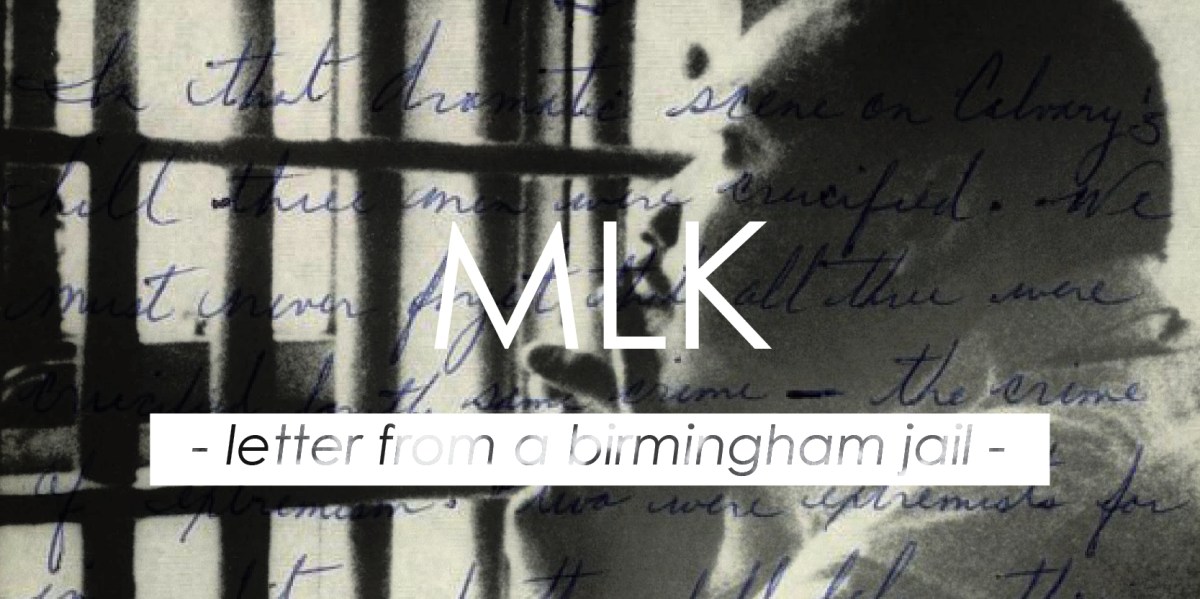
MLK | Letter from a Birmingham Jail

The tune is not very timeless, but the lyrics still communicate. In James Taylor’s 1991 song Shed a Little Light, he wrote

Let us turn our thoughts today to Martin Luther King
And recognize that there are ties between us,
All men and women living on the Earth.
Ties of hope and love, sister and brotherhood, that we are bound together

There is a feeling like the clenching of a fist
There is a hunger in the center of the chest
There is a passage through the darkness and the mist
And though the body sleeps the heart will never rest

Shed a little light, oh Lord, so that we can see, just a little light, oh Lord.
Wanna stand it on up, stand it on up, oh Lord,
Wanna walk it on down, shed a little light, oh Lord.

I don’t know that a nation like ours with a history like ours or a present like ours can turn our thoughts often enough to the otherworldly, redemptive vision of Martin Luther King. Certainly of all the things you might trip into today, be you off work, on work, occupied or otherwise, wouldn’t it be important to spend 10 or 15 minutes swept into the sacredness of King’s vision for justice and equality, but, above all brotherhood and sisterhood? I think so. Don’t neglect to find such a moment during this day. For we forsake those things we forget, even, especially the proverbial first things.

I’m reprinting below the entire text of King’s Letter from a Birmingham Jail. I reflected on it during Friday’s post and gave a bit of its backstory.

I have a bit of a habit of using Monday’s post as a venue for reflecting on art. Can an open letter extolling the expounding upon the biblical and social urgency of racial justice be considered art? Can it be called beautiful, evocative, important, inspiring? In the case of this epistle, the answer is yes to all and so much more. It has its own animate power and presence, the same as any masterpiece. Like van Gogh or Bach, it can stop you in your tracks. If this is not art, than our definition of art must grow. The same could be said of the way this text belongs in many important categories. If you live in America and have never ventured into this text, you are poorer for it. If you are a Christian and have never annexed King’s vision for justice into your own, you have needlessly retarded your spiritual growth. If both are true of you, I would urge you to make this a matter of sacred responsibility—I mean that.

Canadian aboriginal leader George Erasmus noted,

Where common memory is lacking, where people do not share in the same past, there can be no real community.

Where community is to be formed, common memory must be created.

King’s letter offers us a needed path to common memory and, thus, a path to real community—within our society and within the church. How needed this is in these days!

It was King himself who grieved that the most segregated hour in America was 11 am on Sunday morning. How might the American church offer any prophetic energy or insight within our nation if this remains unchanged? It cannot.

And so, without further adieu, I am providing the full text of King’s letter below. May we walk upon its light. Continue reading “MLK | Letter from a Birmingham Jail”