Art often seeps from the gaskets of culture imperceptibly as fluids from an engine. Not until we note the surface-level slick they’ve left do we remark to ourselves, “So that’s what flows around in there!”
The above vase, pieced-together by gilded seams, is a ceramic work by the Korean artist Yeesookyung. It is part of a series she calls Translated Vase.
These pieces are assembled from the discarded shards of Korean-style ceramics. “She acquires her ‘ceramic trash’ directly from an elderly Korean master potter, who intentionally breaks and discards vessels that he feels are imperfect.” [per the museum label at the Smart Museum of Art]
She says of her work:
…what I am trying to do is literally ‘translating’ the … pieces of broken vases and mending their ‘wounds’… The crack, which symbolizes the wound, is emphasized with gold.
Yeesookyung describes her process as being intuitive; she does not impose any predetermined form, but, rather, works in unison with the pieces allowing the form to emerge naturally into its own unique creation. The finished works achieve for themselves a captivating asymmetry. Continue reading “Translated Vases (Yeesookyung)”
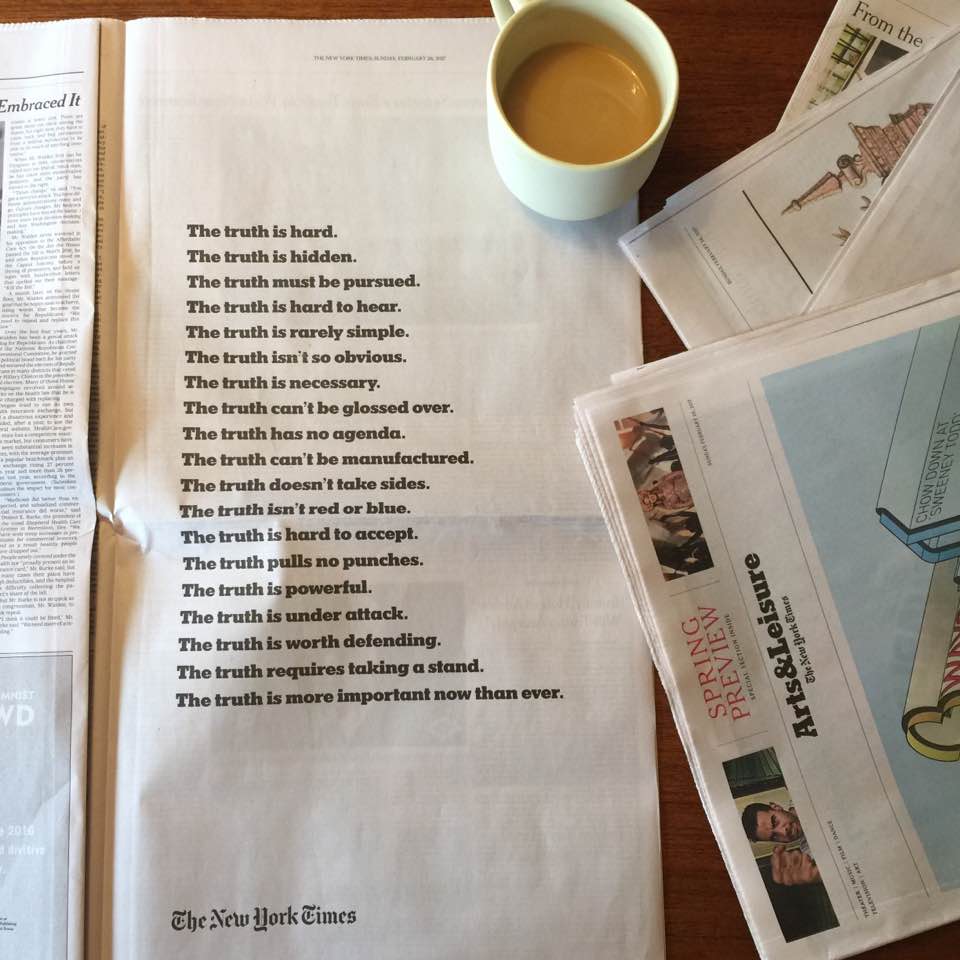
I awoke the next morning to see a picture my friend had posted of the New York Times full page truth ad; accompanied that night by an unprecedented (sp?)TV spot during the Oscars.
I’m not alone! I thought.
As I mentioned in my meta post, the human assignment of life is (to quote Viktor Frankl), “…taking the responsibility to find the right answer to its problems and to fulfill the tasks which it constantly sets for each individual.”
The human assignment is to discover and live in congruence with truth, and, while this is incumbent upon each individual, it is most successfully completed among company. And this is what makes deceit so unnerving, is it not? It makes this assignment an unbearably lonely affair, fraught with risk, threat and painful betrayal; a hopeless, nihilistic errand.
Truth, while absolute and objective, is always arrived at through very subjective processes; what the philosophers call epistemology. Like bats, we echolocate ourselves in a world of darkness, trusting in a dynamic matrix of feedbacks; hoping (needing?) to find them reliable!
This, I sense, was the tenor of the New York Times ad. Truth has no agenda; it simply is. And, like the obstinate, arrogant ship captain insisting an oncoming vessel change course, until alerted that what he’d presumed was a vessel is actually a lighthouse, so too we all must accept that truth is no respecter of power or pride or even position. Continue reading “Truth | #Friday500”
In my last post I referenced the resultant microscopism that comes from situating one’s identity in the political realm—the dehumanized, dehumanizing effects of viewing the world through a political lens.
There are a lot of voices out there right now who are championing the cause of the humane, and Brandon Stanton is one of them. Stanton is, for all intents and purposes, a street photographer—specifically a portraiture . However, his tender, non-critical treatment of his subjects is the poignant power behind what he does.
While typically shooting and captioning his subjects around the Big Apple, he will on occasion take his act on the road. He is currently in Brazil.
The picture and caption below illustrate Stanton’s ability to bring us into human stories. If we are going to grow more philanthropic, it is important to make it the soil in which we plant ourselves. Continue reading “For Your Consideration (03/01/17)”
Emily Dickinson was born in 1830 and died in 1886 at the age of 55. Though considered one of the most important of American poets, she never published a single poem in her lifetime.
Upon her death, her family discovered 40 notebooks containing over 1800 poems. Many were of metaphysical themes—she’d attended some seminary. Dickinson was known to use non-conforming dashes and slashes and other punctuation, making it hard to print her work.
When Facebook first came into existence we were—each of us—required to create a profile. As I recollect, it was displayed fairly prominently. We entered data like: name, birthday, religion and political beliefs.
I remember thinking about that last one a lot (probably too much). Initially, I opted for the term apolitical, because I wasn’t keen on needlessly pegging myself to a political ideology.
Later I landed on a quote by the eminent Gregory Jacobs (AKA Shock G AKA Humpty Hump):
It’s not that I knew Auclair, but the above video of him skiing through streets Trail, BC (from All.I.Can) is only one the most enthralling and inspiring things I’ve ever watched.
The cinematography, the music (LCD Soundsystem) and the skiing—the skiing!—make for a spellbinding piece of film.
There was a phase of my life when I would watch this often. When I think of the power and purpose of art in human living, I can at least attest to its power to inspire; to “give breath.”
When I first laid eyes on the above painting I thought, “Whoa, I guess Bob Ross had a dark side!”
Not quite.
The above piece is titled “Shattered Tree” and it is by the German painter Otto Dix.
Dix was part of a cultural movement-cum-art-exhibition called Neue Sachlichkeit (New Objectivity), which rejected the Romantic sentimental outlook of expressionism.
Understandably.
While many artists, thinkers and spiritual leaders fled Germany during the instability of the Weimar era and the rise of National Socialism, Dix joined others who described themselves as “inner emigrants“—opting rather to live as ostensible immigrants within the boarders of a nation that was becoming increasingly foreign to them.
I happened upon this painting last week at the Art Institute of Chicago and snapped the picture. I’m indebted to Janis Staggs (Curator at Neue Galerie New York) for featuring the piece on her site (as I didn’t initially write down the details). She writes:
…he was classified as “degenerate” under the Nazi regime and went into an “inner emigration” in southern Germany rather than leaving the country. Dix continued to paint during WWII but focused subjects with a non-overt political nature, such as this 1941 painting entitled “Shattered Tree.”
This piece reflects Dix’s thoughts and feelings about the state of his country. It is gloomy. There are signs of death and decay. What appears to be a once-regal tree is now fracturing; cleft by brutal, destructive forces.
And I find myself resonating with the notions of inner emigration, which mirrors St. Peter’s sentiment of living as “aliens and strangers in the land” (1 Pet 2:11), connoting that one can feel like a foreigner or alien within one’s society. The term “stranger” could be translated sojourner, exile, pilgrim or even refugee.
If we ask art to fit into our lingual categories or to say something explicitly, we will often find art loath to accommodate our demand.
Art says those things we cannot say; because they cannot be put cogently into words, can find no hearer on which to alight, and, in some cases, are strictly forbidden (streng verboten).
In this way, art can be a lonely, prophetic business; the voice crying in the wilderness! And yet art also has power to ping the cosmos; to transmit though space and time the message, “You are not alone!”, and, perchance, to be pinged back.
They say one of the more unexpected perils of being buried in an avalanche is that when you find yourself entirely encased in snow (having been tumbled repeatedly), you simply cannot sense which direction is up. If you were able to get your limbs free and start digging yourself out, the chances are high that you’d start digging the wrong direction; maybe even further down.
There’s a trick though. You spit. You dig out a little cavity around your face and spit. Depending on which direction your spit goes, you can orient yourself—you can determine which end is up!
Have you ever found yourself upended? I’m not necessarily talking about catastrophic circumstances, though they may lead to the upendedness I have in mind. But have you ever found yourself not knowing which end is up? Not knowing whom to trust (even one’s own thoughts), not knowing how to make sense of things, afraid you may be digging yourself further in?
Here are a few of the things that have been meaningful to me (and my family) recently.
It occurs to me that posting these is sort of my effort to invite you in on my own journey. As I’ve mentioned before, I appreciate hearing from you as a reader!
As shall be my custom, I will list them in order of how much time they’ll require of you.
BROTHER (THE BRILLIANCE)
On the inspiration of a friend, I assembled a “Sunday Morning Mix” on Spotify. Another friend had just introduced me to The Brilliance, and a few of their songs were promptly included. They are wonderful; contemplative and rich without become too melancholic.
We had a birthday dance party for my 9-year-old, and she actually asked for us to play one of their songs.
Brother (video above) is the one the whole family keeps singing. Maybe you’ll want to start the video and listen to the song while you look down this list. Maybe it will get stuck in your head, too.
His name may prove hard to spell, but his beautiful hand-drawn infographics make information easy on the eyes. Makes me think (hope?) we would’ve been kindred spirits.
It is Black History Month, so here’s the first part of his bio from the site:
William Edward Burghardt “W. E. B.” Du Bois — sociologist, historian, activist, Pan-Africanist, and prolific author — had also, it turns out, a mighty fine eye for graphic design. Born in Great Barrington, Massachusetts in 1868, Du Bois studied at Fisk University, Humboldt University in Berlin, and Harvard (where he was the first African American to earn a doctorate), and in 1897 he became a professor of history, sociology and economics at Atlanta University.
LECRAE HUFPO PIECE ON #BLM
Grammy Award-Winning Christian hip-hop artist Lecrae wrote a piece about Black Lives Matter for the Huffington Post. Having spoken up about his passion for the issues represented in this movement, he went from paragon to pariah in the eyes of many. This piece was his response (back in October 2016). It’s sad and sobering.
I would encourage anyone with misgivings about the BLM sentiment and movement to dive deeper than soundbites or political point-scoring. As a Christian, I would say this is paramount at this point in our nation’s history.
It’ll just take about 10 minutes to read.
SCANDALIZING CHRISTIAN WRITING
Jessica Hooten Wilson is an English Professor at John Brown University, and she makes the following confession:
For three years, I judged Christian novels for Christianity Today’s Novel of the Year Award. One year it was almost unbearable. I found the contenders all but unreadable.
Her article on FathomMag.com goes on to address the dearth of scandal in Christian writing. I’m certain her article could be more broadly applied to Christian art in general.
Something I’ve been giving more thought to of late is a Christian value and understanding of art. I’m still not certain how I’d elucidate my view of art and its importance, but I remember with pangs those times I’ve brushed up against certain offerings of art done in the name of Jesus. To quote our president: “Not good.”
The page will tell you its a 6 minute read. I’m a slower reader, so we’ll go with 10.
In this video, Tim Keller and Bryan Stevenson share on the Biblical concept of justice and what it looks like in practice. (On a separate note, I was surprised to see my friend Susan Nacorda moderating … so deftly, I might add.)
There’s a diner perched on the cliffs of Ft Lee, NJ, overlooking the Hudson River, George Washington Bridge and the skyline of Manhattan. It’s an unassuming establishment, but the locals love it dearly.
They specialize in the fare of lunch; soups and salads and (especially) sandwiches.
Here Reubens and Clubs are both so simple and so savory as to be almost paradoxical.
Long before farm-to-table or artisan foods found their way into the popular vernacular, the proprietor of this diner understood the near sacred importance of provenance and preparation of meats, cheeses, vegetables, herbs and spices. Without fanfare he sought and found ingredients that gave their food a singularity of character. And almost unawares, they calibrated perfect proportions and parts.
Call it happenstance, but the folks of Bergen County knew it was truly sublime.
One such item on the menu was their BLT. Down 4 from the top on their sandwich list, one could nearly fail to notice it whatsoever. But, having tasted the tang of sourdough and mayo awash in the sweet pop of tomato, crisp butter lettuce and etherial applewood bacon, one could not henceforth overlook it easily. If not a miracle, it was at least a phenomenon. Continue reading “BLT”

 HUMANS OF NY


 Matthew Podszus