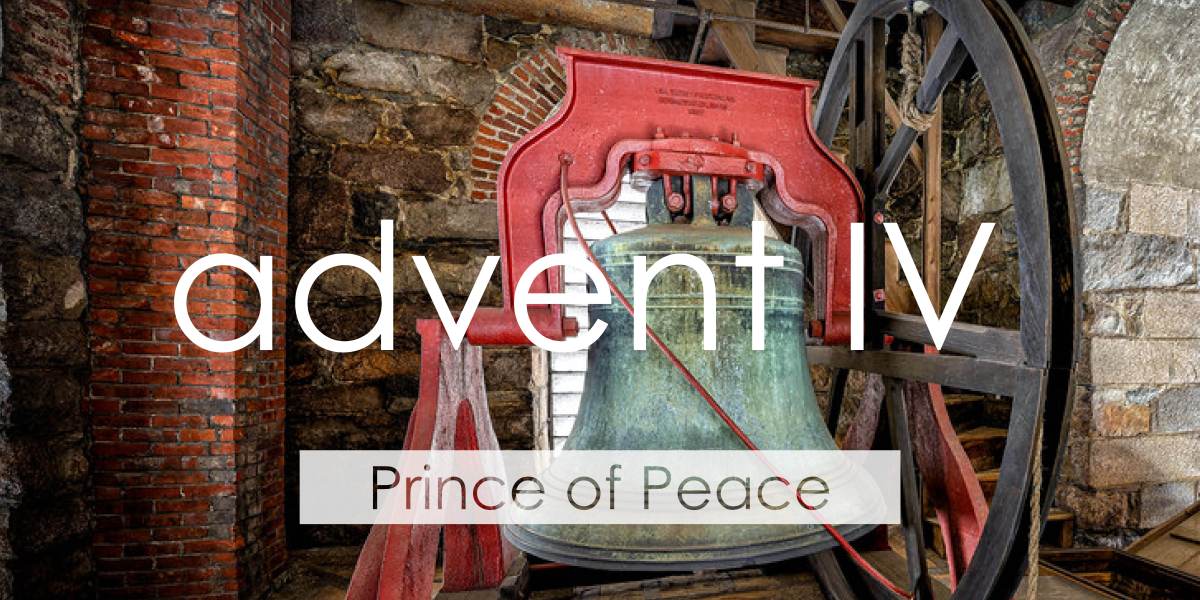
Advent IV | Prince of Peace

In February of 1945, during the final months of World War II, a decorated Soviet commander serving in East Prussia was arrested by Red Army intelligence officers. Letters to his friend had been intercepted containing criticisms of Joseph Stalin and the Communist Party. He found himself swept up with untold multitudes into the secretive Gulag system, where he would shuttle through their murky network of labor camps for the next eight years. His name was Aleksandr Solzhenitsyn and he was 27 years old at the time of his arrest.

In this arrest—which he called “an unassimilable spiritual earthquake”—his perception of enemy and friend was wrenched disfigured. He listened to the celebrations of the German surrender on the streets from his mirthless cell. It was enough, he wrote in his account The Gulag Archipelago, to cause one to “slip into insanity.”

Is anything more tantalizing than peace? Is anything more tormentingly elusive? Nevertheless, Advent arrives perennially with songs and sacred texts brimming with sentiments of “peace on earth and goodwill to men!” (Luke 2:14) The angel choir sang these lyrics to shepherds stationed above the hamlet of Bethlehem, yet the glad tidings they hastened to herald soon beckoned atrocities of a jealous despot and days of weeping without comfort.

The abolitionist poet Henry Wadsworth Longfellow took up the phrase in his poignant poem, “I Heard the Bells on Christmas Day,” writing on Christmas of 1863 while the tolling bells of Civil War deaths were temporarily spelled by “old, familiar carols”:

And wild and sweet
The words repeat
Of peace on earth, goodwill to men!

The bloodiest war of our nation’s history raged on. His wife of 18 years had only just died. His son had only just returned home from the front seriously wounded. And Longfellow was doing his own battle with these wild and sweet words.

Continue reading “Advent IV | Prince of Peace”

Advent III | Everlasting Father

Several years ago I was mentoring a kind young man. He was very smart, a successful college athlete, teachable, and sincere in his desire to grow spiritually. I remember him mentioning that he’d been helped by a book exploring the idea of the father wound, and was especially keen on seeing his own father wound healed. His parents were divorced and his dad did seem to be a real piece of work.

There were certain self-destructive patterns in this young man’s life; burst of growth and confidence followed by periods of regression and tragic lostness. Running perpetually in the background was his complicated relationship with his dad.

As his graduation approached, the complexity of this relationship assumed the foreground. The events and gatherings surrounding his commencement had become a contested space for his parents; what had previously been a demilitarized zone began to flare in conflict. My friend was the epicenter of the conflagration, and it was taking its toll. We spoke more and more candidly about what was going on, especially the outbursts of anger his dad was exhibiting. Still, we spoke in generalities, and I counseled him from these generalities. But things were clearly very bad.

At one point he alluded to the types of angry texts he’d been receiving from his dad in response to perceived slights or offenses. “What does he say in these texts?” I asked.

“It’s pretty bad,” he answered.

“But what is the general message? What is being communicated?” I wanted to understand the nature of these transmissions and the double-bind my friend was laboring to negotiate.

“You want to read some?” he asked. I paused for a moment. Though I have mentored many men and women over the years, it is rare to have such direct access to the personal tributaries of their lives – especially from parents. This is holy ground.

“Only if you felt ok with sharing them and thought it might help me have a better sense for what you are dealing with.” I replied. I could tell this was increasingly hard for him to convey.

“I’m ok with it,” he said. “As long as the language doesn’t bother you.”

“I’m fine with some bad language,” I said.

He pulled out his phone and fiddled with it a bit, finding the last exchange with his dad. He handed it to me and the pixelated screen tore like a gash into the Inferno. As my thumb moved from top to bottom, scrolling down message after message after fiendish message, my eyes welled with tears.

“Is this typical of him?” I asked, glancing up to meet his eyes.

“Yeah.” he said. “This is pretty much the way he’s always talked to me.”

“I know you know this,” I told him in a solemn hush, “but this is very abusive.”

“I know,” he confirmed.

Every single word – hundreds of them, discharged like rounds from an assault weapon – were targeted to kill my wonderful young friend: a malicious, menacing, profanity-polluted barrage issuing from the screen of this man’s phone; issuing from the deranged soul of this man’s own father.

The father-wound. He knew – we know – but not the half of it. We deprecatingly call these “daddy issues” to conceal that these wounds are as ubiquitous as they are mortal. “Your wound is as deep as the sea,” wrote the weeping prophet, Jeremiah, “Who can heal you?” (Lam. 2:13)

Can Advent?

Continue reading “Advent III | Everlasting Father”

Advent II | Mighty God

Several years ago I was invited to join an “Ask a Christian” panel on a college campus. It took place in the large programming space of a residence hall and was respectably attended. The idea was very open-ended: come ask a real, live Christian anything you’d want to ask a Christian about.

Two animated young women sat toward the back that night. I could tell by their demonstrative body-language and side talk following responses, they were skeptical. Then I saw one of their hands shoot up:

“How can you really believe there is a good and all-powerful God when there are so many terrible things in this world? Why would God make a world like this; full of so much suffering? If God is good and has all power, why doesn’t he do something about it?”

It was the exact type of question we hoped might come up, and yet sitting there, each of us glancing up and down the panel, it felt like being in a police lineup. Who would step forward, open their mouth and indict the faith? Both women leaned forward as the question crackled through the room. This young skeptic had probed directly to the credibility or incredibility of the Christian faith. She had probed to the heart of Advent.

We Christians give cataclysmic questions like this neat, philosophical names, so as to decrease if not defuse their charge. This one gets called “theodicy” – the conundrum of God (theo) and justice (dike), coined by the Renaissance French polymath Gottfried Wilhelm Leibniz. When faced with a question like this, one can lean back in one’s chair and say, “Ah, yes. The age-old question of theodicy.” In doing so, one firstly distantiates one’s self from the payload of the question and, secondly, insinuates the question to be easily answered.

In fact, the first panelist to respond began by saying, “We all must remember, these are merely logical questions.” (I remember him emphasizing “merely.”) He continued, “They can be very emotional, but are satisfactorily answerable through logical reasoning.” He went on to answer their question through a thoroughly rationalistic framework which, I’ll admit, served as a rhetorical anodyne. Yet I watched the two women squirm during his answer and realized that I myself was squirming. Why? These are neither merely logical questions nor is there any ease in their answering. Advent asserts as much.

Continue reading “Advent II | Mighty God”

Advent I | Wonderful Counselor

Some mornings I sit on my couch with a cup of coffee in hand and a candle burning on the end-table whilst wild forces course through my body: feeling them, honoring them, and allowing them their fearsome presence. Usually I open my bible, usually I say prayers, sometimes I journal. But sometimes there’s too much of a wild rumpus inside to do much else.

On one such morning a while back, I found myself climbing down the spines of these leviathans into certain memories. Important ones. Mostly painful. But there was one that stood out.

The early-’80s are quite vivid for me; though they were a rush a sorrow and bewilderment. I was born in 1975. In 1980 my parents were divorced. In 1982 my dad remarried and a complicated blended family was formed. In 1983 my mom moved across the country to take a job. It was a lot but it was all I knew. It was a childhood punctuated by disruptions.

In what I believe was the summer of 1983, I went to a church camp in the mountains west of Colorado Springs. A sweet little property called Camp Elim. I loved camp. It was a true escape for a hurting boy.

As I recall, each camper was assigned another camper to secretly encourage with little gifts and notes throughout the week. On the final night there was a gift exchange during which each benefactor would be revealed. I had gone to the general store and purchased candy and made a creative little note, tying them together with a piece of yarn. As we made our way into the dining hall (pictured above) we deposited our parcels into a box at the doorway. I was dropping my gift into the box when, to my horror, I saw the candy slip away from the card and the two become separated! I sought to reach out and fix the problem, but there was much commotion, and the gift-box attendee forbid me from doing so, telling me to go inside.

I could not go inside. I was crushed and distressed. Instead I walked to the steps outside the dining hall as the last few campers trickled in and began weeping alone. Looking back, I was weeping in a way that was a little about the tragedy at hand and a lot about cascading tragedies I had no way of comprehending. A barrage of losses that I’d endured in private pain.

I wept and wept. And I knew no one would meet me there. They never did. That was probably why I wept so hard. I knew for certain I would eventually need to walk back into the dining hall empty-handed, red-eyed, disgraced. So I sat on those steps and wept hot tears.

“Hey! Are you ok?” I heard a concerned voice inquire. Through blurred vision, I beheld a counselor standing before me; a young man, maybe 15, with a kind face and a shock of brown hair. His name was Chip. Chip MacEnulty. And he appeared as an angel in my sorrow.

Through a spasm of crying, I recounted what had happened and how I’d been prevented from remedying the catastrophe.

“Let’s take care of that!” he piped. “C’mon!”

He whisked me off to the counselor supply room and immediately found a stash of candy. He gave me construction paper and art supplies, so I could re-create my gift. We secured the candy to the card – using ample tape! I had a moment to wipe away my tears. The whole thing took only a couple minutes, but as I sat on my couch the other morning I was certain it had altered my life.

Chip had met me mercifully in my distress. Chip was a wonderful counselor!

Continue reading “Advent I | Wonderful Counselor”