For Your Consideration (04/26/17)

JaneAddams

THE JANE ADDAMS MODEL (DAVID BROOKS)

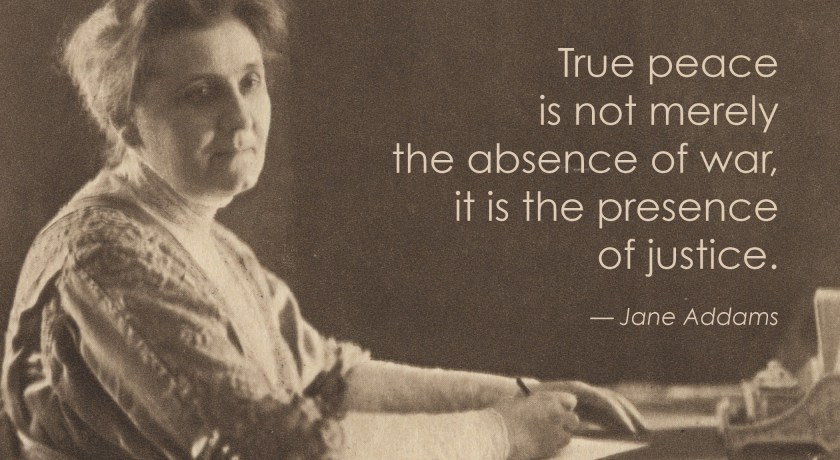
I would recommend David Brooks’  column in this week’s the New York Times lauding social work pioneer Jane Addams and holding her up as a paragon for our modern world.

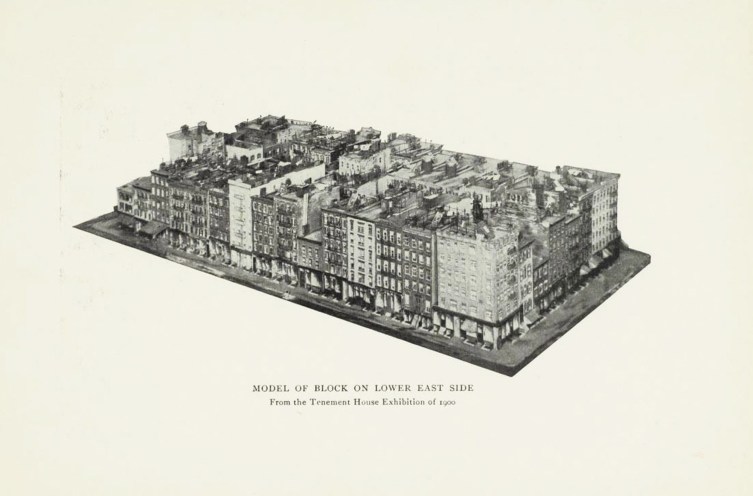
Jane Addams was a forerunner of social work and social welfare. In response to the abject plight of immigrants in the near north neighborhoods of Chicago, she began what would become an extensive, city-wide network of centers. But it began with a work based out of her own home, which came to be known as The Hull-House.

Brooks describes a trip to Europe that inspired her vision:

In London, she visited a place called Toynbee Hall, a settlement house where rich university men organized social gatherings with the poor in the same way they would organize them with one another. Addams returned to Chicago and set up Hull House, an American version of the settlement idea.

I walk past the Jane Addams Hull-House Museum at Halsted and Polk on the UIC campus many times each week, and was piqued to see Brook’s feature of Addams’ work there.

Her ability to constantly merge philosophy with action, and vice versa, was one of her defining qualities. Her aspiration was to kindle the dignity of those with whom she worked.

There were classes in acting, weaving, carpentry, but especially in art history, philosophy, and music. Addams was convinced that everyone longs for beauty and knowledge. Everyone longs to serve some high ideal. She believed in character before intellect, that spiritual support is as important as material support. And yet “the soul of man in the commercial and industrial struggle is under siege.”

I love the notion of fighting against the siege on the souls of men, and appreciate her human dignity-lifting ideals.

Her work would become a global model for how to work among the poor and disenfranchised, and I agree with Brooks that hers remains an important model for our world.

SEE YOURSELF IN OTHERS (TRIBECA FILM FEST)

The Tribeca Film Festival released a short film called “See Yourself in Others”. They involved people from many walks of life, and sent them onto the streets of New York with a five-sided mirror helmet (one which allowed passers-by to see their own reflections atop the body of the wearer, but also allowed the wearer to observe their responses).

It is meant as a provocative celebration of empathy. Curbed NY ran a feature on the piece, which was created in conjunction with DDB New York:

In a statement, Icaro Doria, the chief creative officer of DDB New York (which conceptualized the film along with Tribeca), said that “Stories put us in unfamiliar or uncomfortable situations and force us to confront other points of view.… More than ever, we need these stories and we need this empathy. Because we need each other.”

Initiatives like this only accomplish so much, but any effort to inject empathy into our nation’s bloodstream is welcome.

This resembles the message of my values post:

Currency exchange is probably a fitting allegory we might adopt. The shapes, sizes and hues of values all have their basis and environ of worth. Values are foreign currencies, but currency nonetheless. Would we learn their purchase by going abroad from our insular worlds in whatever ways we might?

RESOURCES ON RACE & RACISM

I intend to follow up my recent post on racism and race with 2-3 more, but, in the meantime, I wanted to recommend a few resources that might help expand on my thinking for those of you who are interested.

On Friday, I offered the following:

We need to be having an important national conversation about race, but the incongruence of our vocabularies render this virtually impossible.

As with all conversations, meaning is irreducibly critical. When meaning is not mutually shared or at least understood, dialogue will always degenerate.

Whites and non-whites mean different things by the word racism, and until this gets more broadly sorted out communication on the topic is fraught with discord.

  • THE LITURGIST PODCAST (BLACK & WHITE: RACISM IN AMERICA) – Hosts Michael Gungor and Science Mike welcome rapper and Propaganda and musician William Matthews on their show to have a fairly elucidating conversation about race and racism in America and in the American church. Pretty pointed.
  • WASHINGTON POST (1992) – As I began my initial search for resources on this topic, I was amazed at how few media outlets were addressing the obvious semantic incongruence between whites and blacks regarding the meaning of the word “racism”. The only article I found that was addressing it head on came from a post-Rodney King verdict article in the Washington Post—in 1992! Isn’t that insane! Here it is.
  • RACE: THE POWER OF AN ILLUSION (PBS) – Back in 2003 (14 years ago), PBS release a 3 part series on race and racism called “Race: the Power of an Illusion”. It feels dated, but it is one of the better options out there for understanding the topic of race. I can’t find episodes 2 and 3, but here’s the first installment. It’s about 1 hour long.
  • VOX (THE MYTH OF RACE DEBUNKED) – If you don’t have an hour, here is a brief video released by the site VOX on the topic. It’s 3 minutes, so pardon the overweening promise. Also, pardon the pretty weak narration. It isn’t always a good idea to have the author do the reading (IMO).  It is a good primer, though. Here’s the video:



For Your Consideration (04/19/17)

SEXISM IN SILICON VALLEY (THE ATLANTIC)

I was traveling on the day I published my Billy Graham Rule post and grabbed the latest copy of The Atlantic (I consider it to be one of the last great magazines). I was intrigued to see the cover issue addressing a related issue, posing the question, “Why is Silicon Valley so Awful to Women?” by Liza Mundy.

For such a liberal and forward oriented industry, it would seem that tech is still very inhospitable to women. How so?

Susan Wu, an entrepreneur and investor, says that when she was teaching herself to code as a teenager, she was too naive to perceive the sexism of internet culture.

But as she advanced in her career and moved into investing and big-money venture capitalism, she came to see the elaborate jiu-jitsu it takes for a woman to hold her own.

At one party, the founder of a start-up told Wu she’d need to spend “intimate time” with him to get in on his deal. An angel investor leading a different deal told her something similar. She became a master of warm, but firm, self-extrication.

How ugly is this? What a backward set of skills we expect of such talented women!

The article goes on,

A report by the Center for Talent Innovation found that when women drop out of tech, it’s usually not for family reasons. Nor do they drop out because they dislike the work—to the contrary, they enjoy it and in many cases take new jobs in sectors where they can use their technical skills. Rather, the report concludes that “workplace conditions, a lack of access to key creative roles, and a sense of feeling stalled in one’s career” are the main reasons women leave. “Undermining behavior from managers” is a major factor.

Our nation is fumbling through many things right now, but degradation of women is certainly one of the items at the forefront.

The battle of the sexes is a human issue immemorial. It’s so morbidly fascinating that even in such a modern and liberalized setting as Silicon Valley, men are still so prone to devolution, isn’t it? Continue reading “For Your Consideration (04/19/17)”

For Your Consideration (04/12/17)

stownmaze

CAN JOHN B.’S MAZE BE SAVED?

Having just concluded S-Town—that latest specimen of the meteoric podcast—I can assure you I am still ingesting the carcass of its moral. I’ll probably be ready to offer something cogent next week. Or not.

But for now, I happened upon this article by Cory Scarola from the (kinda cool, kinda geeky) site Inverse Culture detailing just how challenging it might prove for fans of the podcast to enact the salvation of John B. McLemore’s Woodstock, Alabama maze. (Even harder than enacting his own salvation?)

I’m one of those people who don’t want anything meaningful to befall demise or even deterioration, but ours is a world ushered along by entropies of many varieties. Continue reading “For Your Consideration (04/12/17)”

For Your Consideration (04/05/17)

Trump Housing Bloc

FRIEDRICH TRUMP (THE NEW YORKER)

On October 19, 1885 the S.S. Eider completed its 12 day journey from Bremen, Germany and entered New York Harbor.

Aboard that ship was a sixteen-year-old barber’s apprentice named Friedrich Trumpf; our current president’s grandfather.

Ted Widmer of The New Yorker wrote this perceptive little profile of Trump (the F was dropped shortly thereafter) and the US immigration context into which he was thrust.

There is a subtext, but it doesn’t read like a polemic. You’ll probably appreciated it.

He writes,

On the day the S.S. Eider arrived, New York’s many newspapers advertised their headlines to passersby. The Times tried to cloak its news with a veneer of respectability, but the sounds of the street could still be heard through the newsprint. In Ohio, Democrats were decrying “technical and stupid blunders” in a local election. In Terre Haute, Indiana, a “bold real estate operator” was “dodging the law officers and leaving heavy debts behind him.” In Elmira, New York, a “rich farmer” was swindled by two “wealthy appearing men” who purported to be building a mill.

Somehow I can’t help thinking that if we can become better at humanizing one another (of which heritage appreciation plays a role), our nation could limp forward.

Let’s keep giving it our best. Continue reading “For Your Consideration (04/05/17)”

For Your Consideration (03/29/17)

netflix-abstract-1a.png

Happy Wednesday! Here are some things for you to check out!

ABSTRACT (NETFLIX)

Netflix is really on a streak of late. “Stranger Things” was the icing on the cake of Summer 2016. “The Crown” has carried us through the Winter. (I’ll get to our Fall bonanza below.) Apart from the overall meh of “The Get Down” (which I was pretty excited about), I’ve rarely been let down by Netflix original content.

So when I happened up “Abstract: The Art of Design” a few weeks ago I was optimistic. It does not disappoint! Watch one episode and you’ll probably be hooked! (Unless a designer ran over your dog once  or something. If that happened. I’m sorry. This should have had a trigger warning.)

Firstly, it profiles pretty fascinating figures. Secondly, it is produced beautifully—wonderfully. It is itself a well-designed docu-series, as it should (must!) be.

A quote from wunderkind Danish architect Bjarke Ingels (founder of the Bjarke Ingels Group, or BIG) summarizes the message of this series nicely:

I like this idea about architecture being a way to manifest your dreams into the real world; almost like a shaman with brick and mortar.

That is the true power that we as humans have. We have such a massive impact on our environment, so, now that we have this power, we can either use it to create a nightmare  or we can use it to realize our dreams.

And of course the latter is much more interesting.

What a great picture of imago Dei and of the notion that imagination is indeed the most human of capacities (see my reference to this and niche construction from last week.)

Go watch it. It’s probably better than whatever your watching right now, and it’s only  8 episodes.

THEO EPSTEIN (WORLD’S GREATEST LEADER)

On November 2, 2016 I tweeted the following:

The Chicago Cubs had just won their first World Series since 1908. (Maybe you heard?) I was imagining a chariot swooping down from the sky to pluck Cubs GM Theo Epstein out of the trophy presentation Elijah-esque (I mean, he is Jewish).

Even most casual baseball fans know that as GM of the Red Sox and Cubs, Epstein helped break the two most infamous curses in baseball lore: the Bambino and the Billy Goat, respectively. I live on the Southside of Chicago, but after the Cubs won my hood immediately became an all-out-party (complete with fireworks).

And now Fortune Magazine has named Epstein “The World’s Greatest Leader”. (Please tell me it comes with a coffee mug!)

Tom Verducci author of The Cubs Way provides a nice accompanying piece on what makes Epstein special. At the start of his Cubs tenure, scouting reports began to delve deep into the mettle of every player they were considering—even asking how they treat those whom they can afford to treat poorly!

Verducci writes:

Cubs scouting reports would never look the same again. Epstein wanted reports that went on for pages, like the Russian novels his father had him read as a boy. The scouts who didn’t take to the long-form scouting reports didn’t last. Epstein ran them off.

It wasn’t hard, measurable data. But it was information nonetheless, and if Epstein was going to build a team around high-character, high-impact position players, he wanted as much of it as possible.

Epstein conveys his sentiments the following way:

When people do things they weren’t even sure they were capable of, I think it comes back to connection. Connection with teammates. Connection with organization. Feeling like they belong in the environment. I think it’s a human need—the need to feel connected. We don’t live in isolation. Most people don’t like working in isolation—some do, but they typically don’t end up playing Major League Baseball.

And so Epstein applied the rigorous data-based Sabermetrics approach that made him successful in Boston (as profiled in the book and movie Moneyball), but added the soft data of character in the hopes that, in his words, “our environment will be the best in the game”. And his aim is that this would make their success last! Cheers to that!

How did Epstein react to the news? As you’d expect from any truly great leader:

Um, I can’t even get my dog to stop peeing in the house…

And I’m not even the best leader in our organization; our players are.

As I read this I can’t help but think, “Yet, I have gotten my dog to stop peeing in the house.”

BRYAN STEVENSON (#16)

Speaking of Fortune’s list of the World’s 50 Greatest Leaders.

Though he didn’t top this list, Bryan Stevenson (Executive Director of the Equal Justice Initiative and author of Just Mercy ) did land at #16!

This is very heartening to me. I mentioned Stevenson a few weeks back and commended his appearance with Tim Keller during Redeemer Presbyterian’s Center for Faith and Work series.

It seemed like a good time to share his electrifying TED talk. You rarely hear TED audiences break into applause, but they did so multiple times during Stevenson’s message. (Watch it!)


Speaking of Tim Keller…

PRINCETON SEMINARY SNUBS TIM KELLER

Princeton Theological Seminary intended to honor Tim Keller with their Kuyper Prize for Excellence in Reformed Theology and Public Witness, but reversed course—they un-awarded it to him—on the basis that the award could “imply an endorsement”.

Jonathan Merritt of Religion New Service wrote his objection to the decision, saying:

To be clear, PTS has the right to honor whomever they wish. They are not obligated to let Keller speak, much less grant him this award. Setting this aside, we must ask, “How does marginalizing Tim Keller make the world a better place?” And since we’re talking about a seminary, we might add, “How does it promote unity among disparate churches?” The answer to these questions is the same: It doesn’t.

The OpEd is well put. And it introduces the critical question of how we give space to those with whom we disagree (even on important stuff). This seems like an issue our nation needs to confront at present.

As seen during the recent protests at Middlebury College and even the University of Chicago’s decision to push (shove?) back on the ideas of “safe spaces” and “trigger warnings”, we don’t seem to know what to do with ideas that are divergent from our own. We don’t know how to separate ideas from those who hold them—”love the sinner, hate the sin.” And we aren’t differentiating between ideas that are uncomfortable versus dangerous or harmful.

Does interface with ideas equate to “endorsement” or “legitimizing” of them? This tugs at the fabric of what makes any civil society function, doesn’t it?

How does our society find a way forward, when we cannot find a way to interact with any ideas that make us uncomfortable?

Obviously, this presents many challenging questions for us, and there are no silver bullets. But I wonder what can be done? I’d welcome your thoughts!

For Your Consideration (03/22/17)


light-bulb-1246043.jpg

IMAGINATION AS HUMANNESS

Christians believe that the essence of humanness is the imago deithe “image of God”.  In other words, we are human insofar as we mirror the qualities of our Maker.

As I interact about this topic with college students, I invite them to observe two fairly obvious characteristics of humanity: (1) that we are singularunlike any other species in terms of what we are capable ofand (2) there is clearly something very wrong with us. No other species enacts such ugliness and evil.

And so I was intrigued by the review of the book The Creative Spark by Agustín Fuentes, the chair of Anthropology Notre Dame, in the Economist.

He argues from the idea of niche construction (studying how animals interact with their environments) that humans are “niche constructors extraordinaire”. There is almost no limit to which humans shape the world around them. (Unlike, say, a beaver who is limited to waterways and trees.)

His conclusion?

Imagination is what makes us essentially human. Continue reading “For Your Consideration (03/22/17)”

For Your Consideration (03/15/17)

In the spirit of Saint Patrick, I’d like to offer some selections this week around the theme of seeing and responding to the needs of others rightly—if riskily.

I tend to gather a pretty ecclectic offering, and today isn’t really different. However, today’s mix leans heavily toward those speaking from a Christian perspective.

The Christian instinct for human compassion has been under duress of late. Sadly, some Christians have invited the onslaught. But let’s round out the picture, shall we?

THE BRILLIANCE (DOES YOUR HEART BREAK?)

I referenced the Brilliance awhile back, and thought this song was a fitting accompaniment to today’s selection.

It begins,

When the walls fell
And the hungry child
Cried out for help

Did you hear the sound?
Did your heart break?
Does your heart break now?

Continue reading “For Your Consideration (03/15/17)”

For Your Consideration (02/08/17)

HEY ROSETTA! (KINTUKUROI)

One of the things I’ve enjoyed about writing, is the way it fosters new connections and ideas through the power of conversation.

After my last post (featuring the art of Yeesookyung and the Japanese Kintukuroi  method), I was made aware by a friend of the band Hey Rosetta and their song of based off this art form.

They draw many inferences that jibe with what I wrote. Here are some lyrics:

Oh stand in front of me
Open your eyes like you know me

Oh see inside of me
Lay the heels of your hands upon me
And let your fingers fall

Bless the broken bowl
Make it whole, make it better than it was before
Make it better than it was before!

Continue reading “For Your Consideration (02/08/17)”

For Your Consideration (03/01/17)


sof_onbeingHUMANS OF NY

In my last post I referenced the resultant microscopism that comes from situating one’s identity in the political realm—the dehumanized, dehumanizing effects of viewing the world through a political lens.

There are a lot of voices out there right now who are championing the cause of the humane, and Brandon Stanton is one of them. Stanton is, for all intents and purposes, a street photographer—specifically a portraiture . However, his tender, non-critical treatment of his subjects is the poignant power behind what he does.

While typically shooting and captioning his subjects around the Big Apple, he will on occasion take his act on the road. He is currently in Brazil.

The picture and caption below illustrate Stanton’s ability to bring us into human stories. If we are going to grow more philanthropic, it is important to make it the soil in which we plant ourselves. Continue reading “For Your Consideration (03/01/17)”

For Your Consideration (02/22/17)

Friday’s post involved an avalanche illustration, and I couldn’t help feeling a pang of sorrow about the death of skier JP Auclair in September of 2014 in an avalanche. He was skiing for a shoot in Chile when it happened.

It’s not that I knew Auclair, but the above video of him skiing through streets Trail, BC (from All.I.Can) is only one the most enthralling and inspiring things I’ve ever watched.

The cinematography, the music (LCD Soundsystem) and the skiing—the skiing!—make for a spellbinding piece of film.

There was a phase of my life when I would watch this often. When I think of the power and purpose of art in human living, I can at least attest to its power to inspire; to “give breath.”

I would watch this and think, “Is there anything I want to do this beautifully? What would it take to make that happen?” Continue reading “For Your Consideration (02/22/17)”