Coming of Age

Watch this brief TED talk first.


Cultures have coming of age traditions and ceremonies; common, ritualized practices that denote a passage into adulthood and accountability. Typically these are imbued with honorific signals to ancestral heritage, community legacy, mores and customs, and the privileges and responsibilities of maturity within society.

Listening to the poet Clint Smith share his own story, I was grieved by what I know without any doubt is the Black American ceremony of alerting adolescent children to the hazards of their Blackness. This is the coming of age tradition our nation has foisted upon this community.

So, of all the affirming and empowering messages any Black adolescent receives from loved ones, those who are their loved ones and who love their lives, the safety of their bodies, the sacredness of their destinies must love them by cautioning them that their humanness is, at best, tenuous in our society.

If, as Christians or even conscientious Americans, we cannot extend grief, anger, and a will to affect something better toward this precious community–our neighbors–than we must wonder of defectiveness of our own humanity.

Dr King wrote,

“It may be true that the law cannot make a man love me, but it can keep him from lynching me, and I think that’s pretty important also. It may be true that the law cannot change the heart, but it can restrain the heartless.”

I believe the Civil Rights Movement of the middle of the 20th century was largely an urgent effort toward “legislation to control the external effects of those bad internal attitudes.” We need to remember that there were 4000 lynchings between 1877 and 1950 in the US. One each week. There were also law enactments and enforcements that led to de-facto re-enslavement of Black Americans through share cropping, convict leasing, and widespread intimidation.

The Great Migration was, in actuality, a great refugee movement, because in the South humanness (especially male humanness) was a capital offense. In the North and West, Blacks were introduced to James Crow via segregation, red lining, violence, and dehumanizing discrimination.

When King lived and campaigned in Chicago, he was pelted with stones, spit upon, and met with an open hostility he’d not even experienced in Mississippi. In a speech at Soldier Field in 1966, he famously lamented,

“We are tired of being lynched physically in Mississippi, and we are tired of being lynched spiritually and economically in the north.”

King saw education and spiritual transformation as the only gateway to change in attitude–to “make a man love me.” But these things can only take place voluntarily. Any therapist will say, “You have to want to change.” Do we? Do we want a society in which Clint Smith’s kids can receive a totally different coming of age talk; one that reflects the simple premise that Black lives matter?

If our Civil Right forerunners gave their lives to create a legal framework in which the slaughter and degradation of Black life might be mitigated, how must we give our lives to continue their moral legacy? And should it cost us nothing?

Clint Smith is 31. That means his dad gave him this fierce and fearsome talk in 2001. My Black friends are still giving their kids this talk in 2020.

Tamir Rice was 12.

White friends: what talks are we giving ourselves and our kids? If we have no answer, then we are leaving this sad legacy in place; leaving the weight of these dehumanizing talks to the Black moms and dads and loved ones in our nation. We are not calling the Black community our loved ones for we are not loving them as we must.

A friend visited me last year in Chicago. He was taking his son on a 13 year-old father-son right of passage trip. One night while he was here, I asked, “How are you approaching this time?” He said there were a lot of things they were talking about, but that night he had told his son, “You were born a white male in America. That means you won the lottery. You have got to be very clear about how to use your privilege rightly.” It brought me to tears.

This must be a literal “come to Jesus” for us. Silence is betrayal in our public spaces and silence is betrayal in our private spaces. Being human means naming and defining. For the Black community, this means naming and defining racism, White supremacy, and the lethal threat these represent to Black bodies and souls. For Whites, this must be naming and defining racism and White supremacy in our bodies, souls, communities, institutions, and society–including its lethality.

In his book The Hidden Wound, Wendell Berry wrote,

“If the white man has inflicted the wound of racism upon black men, the cost has been that he would receive the mirror image of that wound into himself.”

What he is saying is something we all know innately: as White people, our humanity is wrapped up in this also. No person can dehumanize or benefit from dehumanization without compromising their own humanity.

This is inherently Christian.

I would argue it is inherently patriotic.

This is inherently human.

Smith said, “I refuse to accept that we can’t build this world into something new.”

White friends, this is something we must refuse to accept also.

White Christian friends, this is part and parcel of our yes to Jesus.


The work of the Gospel

May has been brutal, and I’m tired. I know so many of us are. There are many varieties of tiredness, but the tiredness in my life is that of heaviness and grief.

The psalmist David expressed it thus,

I am worn out from my groaning.
All night long I flood my bed with weeping
and drench my couch with tears.
My eyes grow weak with sorrow;
they fail because of all my foes.

We use the word brutal in a spectrum of ways, and May has encompassed them all. At the beginning of this month we witnessed the devastating footage of Ahmaud Arbery’s February 23 murder, in which this black jogger was hunted down and shot in cold blood by a father and son. More than that, we were dismayed by the realization that months had gone by since the killing with no meaningful response by law enforcement. The gaping chasm of this knowledge bespoke something sinister and unsettling.

And we groaned. We groaned, as for a world unlike this one: we cried out, we ran, we sent letters, and made phone calls. Days later we became aware of the terrible shooting of Breonna Taylor by police in her own home in Louisville, and of the miscarriage of justice surrounding it. Our eyes grew weak with sorrow.

Then, in the span of one day, we observed a confrontation in Central Park, in which an embarrassed white woman appeared to summon a dark force against a conscientious black man who had simply asked her to abide by park guidelines. Later that same day came the appalling footage of George Floyd’s killing by Minneapolis police officer Derek Chauvin, whose fellow officers warded off a crowd of bystanders attempting to intervene. The juxtaposition of these two events seemed undeniable points within a connect-the-dot. I was on a Zoom call that night and, as I began sharing about this, I found myself crying.

We are prone to call these deaths senseless, but what is most troubling is that they seem governed by a sense—the sense of what is commonly called evil. They are not senseless—they make all too much sense. Our strength fails because of foes. We’re reminded of the powers and principalities at work in this dark world, against which we contend. (Eph. 6:12) We were being allowed to see the gears of a system of mechanisms operating with chilling efficacy as from cruel design. And we were shaken. The earth opened up to unleash a flood of heat. The streets began to burn.

So much could (should) be said and done in response to this. And I agree with so many who are reminding us that this not a sprint but a marathon. But I want to speak as a Christian to Christians—especially white Christians—by saying, The Gospel of the Kingdom pertains to each and every part of this. Do not be convinced otherwise.

As John wrote, “The reason the Son of God appeared was to destroy the works of the devil.” (1 Jn 3:8) Family, there are few works of the devil with the enormity of carnage than race, racism and white supremacy. There is a pervasive and intransigent mindset in white evangelical communities that working for justice and equality is somehow “a distraction from the work of the Gospel.” But let us reject that. Any so-called ‘Gospel ministry’ that does not speak and act forcefully against the social evils of racism and white supremacy is unrecognizable from the Gospel and the Kingdom of God we encounter in Scripture.

I would argue this internal reluctance experienced within the white Christian community is itself an essential part of the machinery of darkness, because it derives its energy from fear and not love for God or one’s neighbor.

Until justice is permitted to shape our moral imagination, until this can become robustly integrated into our discipleship and disciple-making, we only remain perplexed and passive—and silent. Meanwhile our world is wondering why the Church so often goes hoarse in these moments—if not tacitly siding with injustice. (As silence always does.) Jesus, who came declaring, “Repent, for the Kingdom of Heaven is at hand,” (Mt 4:17) and exclaiming, “the Kingdom of God is already among you!” (Lk 17:21) has given us a prophetic place in this world—a prophetic identity!

“You are the salt of the earth,” Jesus said. “You are the light of the world!” In losing our saltiness, we void our very identity. In refusing our luminosity, our purpose is forfeited. “Let your light shine before others,” the Savior continued, “that they may see your good deeds and glorify your Father in heaven.” (Mt 5:14-16) Do they see the goodness of our deeds; the moral clarity of our voice?

Dallas Willard wrote,

“The greatest issue facing the world today, with all its heartbreaking needs, is whether those who, by profession or culture, are identified as ‘Christians’ will become disciples – students, apprentices, practitioners – of Jesus Christ, steadily learning from him how to live the life of the Kingdom of the Heavens into every corner of human existence.”

Do we accept this description of discipleship or something less?

What, then, is “the Kingdom of the Heavens”? We are given a tantalizing picture of its culmination in the book of Revelation.

Firstly, it is a populated by “a multitude too large to count, from every nation and tribe and people and language.” (7:9) We are told that this “Great Community” was exactly what Jesus gave his life see realized.

Secondly, “the glory and honor of the nations will be brought into” its capital city. (21:26) That is, all humankind will be represented there, and all will have honor.

Finally, it will be a place where there are no tears, no pain, no mourning, no death. Why? Because “the old order of things has passed away.” (21:4) The old order of things will pass away. This is significant. Say it to yourself: “The old order of things must pass away.”

As Christians, we often pine for this day … as we must, for this is our hope. Yet it is also our love, and Jesus taught us to pray, “Your Kingdom come, your will be done on earth as it is in heaven.” (Mt 6:10) The governing concern of our life, Jesus insisted, is to “seek first his Kingdom and his righteousness.” (Mt 6:33) That word righteousness can just as easily be translated “justice.”

If and when we are about following Jesus and teaching others to do the same;  learning together as would-be followers “how to obey everything he has commanded,” (Mt 28:20) we cannot exclude our obligation to be justice-bringers in this world—if for no other reason than our common “hunger and thirst” for it!

In his book Bring Forth Justice, Waldron Scott noted, “We are accustomed to discipleship, in part, as ‘separation from all known sin.’ In practice we limit ‘all known sin’ to personal misconduct… We do not take seriously our involvement in structural evil.”

The “old order” is the order of this age, and we must help it pass away as members of the Kingdom. This must become an ongoing and significant aspect of the good fight that is ours to join. It is a fight. A fierce one. The fight is decidedly against an entire order of things—with dark powers and principalities behind it. It is a brutal system to which the brutalities of May attest. Our confession and fidelity to Scripture makes this clear.

Much speculation of late has taken place around how a bystander should handle an occasion of police brutality or racial violence. What would I have done if I was on that Minneapolis street or in that Georgia sub-division? It is a fair, if abstract, thought, and I believe it comes from a deep sense of obligation. Most of us, however, will not be present for something so horrific, yet all of us are present and participatory in a society that has yet to act with anything close to the appropriate urgency deserving its evil animations. In this regard, our opportunity is quite concrete.

Having received the moral imperative to, in Messianic words of Isaiah, “faithfully bring forth justice,” (42:3) we might apply our faith to this assignment from our Lord. We might employ our whole arsenal therewith; speaking and acting, praying and promise-claiming,  all the while keeping in mind, “The weapons we fight with are not the weapons of the world. On the contrary, they have divine power to demolish strongholds.” (2 Cor. 10:5) So we might come against these evils by prayer and fasting and worship … and intentional efforts!

In our fatigue, we can call to mind, “let us not grow weary of doing good, for in due season we will reap, if we do not give up.” (Gal. 6:9) In our discouragement, “my dear brothers and sisters, stand firm. Let nothing move you. Always give yourselves fully to the work of the Lord, because you know that your labor in the Lord is not in vain.” (1 Cor 15:58)

But first we must settle the matter once and for all that this is part of our discipleship. It is not a distraction from the work of the Gospel, it is the work of the Gospel. This need not be to the exclusion of other works of the Gospel; in fact, this can only serve to legitimize our witness and to fortify our spiritual lives.

Let us neither forget nor spiritualize the fact that Jesus himself announced his ministry by taking up the scroll of Isaiah:

“He stood up to read, and the scroll of the prophet Isaiah was handed to him. Unrolling it, he found the place where it is written:

‘The Spirit of the Lord is on me,
because he has anointed me
to proclaim good news to the poor.
He has sent me to proclaim freedom for the prisoners
and recovery of sight for the blind,
to set the oppressed free,
to proclaim the year of the Lord’s favor.’

Then he rolled up the scroll, gave it back to the attendant and sat down. The eyes of everyone in the synagogue were fastened on him. He began by saying to them, ‘Today this scripture is fulfilled in your hearing.’” (Lk 6:17-21)

The eyes of many remain fastened upon those who are called by Jesus’ name. In our day will we see this scripture being fulfilled?  Let us hasten the dismantling of old, sad orders through our toil in partnership with the One who says, even now, “Behold, I am making all things new.” (Rev. 21:5)

Lord help us!

dimension zero

Fog has a fascinating way of demarcating; revealing distance through gradated silhouettes; converting the world into an enormous pop-up book. Have you ever noticed that? Generally speaking, novel conditions have a way of enforcing themselves on perspective—insisting we take notice of things previously undetected.

We’re in such a novel condition. Our whole world mostly is. The effects of this pandemic are expressing themselves in countless ways, and no one can definitely speak to the duration or true meaning of this time. Yet, as the condition’s name suggests, it is pandemic—of all people. Thus it is common.

For me, as with fog, this has brought into stark relief what we call dimensions: our relationship to space and time themselves. I’m going to try to write four posts, each tied to the dimensions of reality. These are mere reflections; a humble prompt for inspection. May they offer you something helpful, should you read them.

Dimension 0 | A Point

Technically speaking, a point is actually no place at all; a null set. It derives its value, its meaning, its space only insofar as it connects to other points. It is the dimension of zero. The dot in the i of Jeremy Bearimy.  There are two symbols for the null set: the slashed zero (Ø) and the empty “curly brackets” ({}). (Yes, I just put curly brackets into parenthetical brackets.) Within the zero dimension we are bracketed thus with curls.

I’ve already written a piece about the present elusiveness of meaning, but, as this moment protracts, this seems even more the case. Yes there is value or, one could say, “values” available. Kindness and patience retain value, reaching out to others within the digital landscape while remaining present to those within our newly-shrunk society, prayer and mindfulness, physical activity and meditation on Scripture, care for self; all these are values within the nebula. And no, this time has not dissolved ultimate meaning; not tossed God from His throne nor totaled the vehicle of Truth. It’s more like we simply cannot find the place on the map reading, “You Are Here.” This type of meaning evades what bible students call “the interpretation” and scientists term “conclusion.” It has the distinct feel of chasing after the wind; literally, “an attempt to herd wind.” “The wind blows to the south and goes around to the north; around and around goes the wind…” (Ecc. 1:6)

This point in space is both a dimension and no dimension at all, which is to say it is a paradox—a mystery. I find that people range from tepid to cold when it comes to mystery. Mystery: a “mouth-shutting-ness.” Forrest Gump has up and stopped running, and we’re left shouting, “Now what are we supposed to do?!” The emphasis is certainly upon the word “now,” a strange track set on repeat.

Days all feel vaguely the same. If you live in Chicago, you have spring, winter, summer, and fall all in one week. We’ve lost track of all of the yearly rituals that have vaporized into the ether: Opening Day and March Madness, Spring Break trips and Proms, weddings and funerals, Holy Week. It is a point whose point escapes us. Tomorrow promises to be much the same. And it is disorienting, no two ways about it, as we discover ourselves scraping and searching for bearings, groping desperately in darkness. Don’t we perceive this pent up energy? Have you been wondering what it’s about?

In the null set we are getting far too much time with ourselves, aren’t we? You are the one self with whom social distancing is regrettably futile, and you’ve become too close for comfort! It was the existentialist philosopher Jean-Paul Sartre who portrayed hell as an eternity in which people are their own tormentors—left alone with the abrasion of their own relentless self-critiques—in his aptly titled play, No ExitThe alarming question appears early, “how shall I endure my own company?”

Doesn’t that question speak to a torment we are all presently enduring? One of the characters in Sartre’s play finds herself wondering when the tormentors will arrive, and the valet asks her how she would recognize one. Her answer? “They look frightened.” This amuses hell’s valet, “Of whom would they be afraid? Their victims?”

“Laugh away,” she replies, “but I know what I’m talking about. I’ve often watched my face in the glass.” This character, Inez, knows inherently that fear is at the center of all torment, and it is alluded that the victim and tormentor shall be one and the same. But why?

Journalist Judith Shulevitz addressed this in her 2003 New York Times Magazine essay, “Bring Back the Sabbath,” bemoaning our “machinery of self-censorship” and the arduousness of “stilling the eternal inner murmur of self-reproach.” Our activity, it would seem, performs an unacknowledged function; it is a noise machine to muffle this irritating murmur, whose droning has largely been eliminated without our consent. (In CS Lewis’s  The Screwtape Letters, Screwtape informs his demonic protégé Wormwood of hell’s intent, “We will make the whole universe a noise in the end. We have already made great strides in this direction as regards the Earth.” Yes they have.)

This condition is what theologians call “ontological lightness”—the perceived weightlessness of our self. As the late Brent Curtis put it, “the reality that when I stop ‘doing’ and simply listen to my heart, I am not anchored to anything substantive. I become aware that my very identity is synonymous with activity.” The discomfort, it turns out, is an existential crisis over which we skate precariously. The calls are coming from inside the house!

So we are all versions of Michael J. Fox’s character Marty McFly striving desperately against the disappearance of his world and very self. It is both terrifying and amusing. It is our corporate plot line. “As soon as they stop performing,” Curtis observes of our culture, “their identities—and ours—disappear.”

Are we the null set? God forbid! Constructed entirely of our doing? Or is there a self beneath it all; one with which we may be at rest, even apart from its productivity, even in naked stillness or newfound ineptitude in performing and producing? Maybe. Maybe not. We’ve never stuck around long enough to find out. 

Faced with her own crisis of self, my friend Kendra penned a poem that is both deeply honest and deeply wise,

Would your dove ever descend on me and say you are well pleased?
I’m not even a son but a daughter, so the quote doesn’t even fit
You speak a foreign language when you say I’m loved apart from what I do
What clothes, skin, and bones do I have apart from my endeavors?

She continues later,

If you unraveled my performance you’d keep going going going
Is there a core it wraps around or simply the end of the string
If it’s just the string God don’t unravel it
I’ll exist no more

The poem ends with a gut-level plea that says so much,

Do you like these words? Will you put them in a book?
Good, then it was worth it. I don’t have to do the real work.
My heart can remain unchanged; just tell me, “wow your heart’s so real!”
Tell me, tell me, tell me so I do not have to feel.

Can the love and pleasure of God actually rest upon those whose ledger of merit reads zilch? Can there be a being with value beneath the yarn once it is all unspooled? Can we avoid having this conversation a little longer? Please? We discover in times like this just how much our lives are a mad scramble to cobble together our sense of self.

The one thing I know is that the “You” in “You Are Here” is precisely where the now has brought us; inescapably so. Are you coming to see how ontologically light you really are? Have you any answer your auto-torment—your own frightened face in the glass? If not, can you re-enter the world with anything but fear and renewed desperation? Or will the you who you are re-enter with greater rest and an enlarged capacity for generosity?

“You have made us for Yourself,” observed the great bishop of Hippo, “and our hearts are restless until they rest in You.” The you who are here,  are made in the very image and likeness of the Creator, and, before a work hour was complete, were beheld to be “very good.” The Dove descended upon Jesus, and, before a single sermon or miracle, the Father’s voice pronounced love and great pleasure; the type of love that defines the object as beloved. And he became “a life-giving spirit.”

You are here.

And, to quote my friend’s poem, “the real work” is before you; to name your noise and restlessness; to claim your silent rest—or at least a taste of it!

Wendell Berry spoke so simply and so poignantly about this “real work” in his poem “Our Real Work”:

It may be that when we no longer know what to do
we have come to our real work,
and that when we no longer know which way to go
we have come to our real journey.
The mind that is not baffled is not employed.
The impeded stream is the one that sings.

In his Noise-lauding letter, Screwtape quotes George MacDonald’s “sickening” description of heaven, “the regions where there is only life and therefore all that is not music is silence.”

“You Are Here,” and here you may remain until the you who is here comes to rest with your self, as defined apart from all of its noise and accolades; to rest in the goodness of your being and belovedness. The “Where” of “You Are Here” may only disclose itself by way of this real work, and although it may remain murky, you will be allowed to orient yourself by the unfamiliar sounds of music and singing—issuing from within, of all places!

As this happens, you will actually have something new to offer; something to give. And you will say along with another poet, Walt Whitman, “When I give I give myself.”


silence

Our world has been flung into a peculiar quiet, and we know not what to make of it.  Life within ‘The Great Pause’ finds us confronted by our craving for noise. More truthfully, we are coming to see how all the noise of our hustling and bustling serves to drown out the clamor within. As we’ve learned from the movies, “it’s quiet—too quiet!”

Streets without traffic, gridlocked minds; public venues stilled, private venues cacophonous; bodies idle yet pent up. There is no telling when this infernal quietness might end. Whoever said silence was golden? It isn’t! Silence is foreboding, if anything. Even monks don’t like the stuff. They spend their whole lives “acquiring the taste.”

During my undergrad I memorized a lot of Scripture. I was part of a group that heavily emphasized it and have never regretted the storehouse it has been for me. During one study group, we agreed to memorize John 14:6 and Luke 6:46. Of course someone got it wrong and committed Luke 14:6 to memory: “And they had nothing to say.” We laughed about this and, naturally, all agreed to memorize this verse as well.

We do have nothing to say. Our politicians and pundits and so-called ‘talking heads’ have seldom been so flummoxed. Even the wise in markets and theology and psychology and science are at a veritable loss. I know I am, middling though my wisdom be. O but we want to say or hear something—anything!

In actuality, it isn’t as though we have nothing to say. There is some good stuff being said; and a lot of rubbish also. But there is saying and there is saying. It’s the second one that is in scarce supply at present—like toilet paper and rubbing alcohol.

I’m fond of a vignette that is found toward the conclusion of Matthew’s Gospel. Jesus has invited his three close companions John, James and Peter on a hike to the summit of an arid mountain in northern Galilee. Atop the peak, Jesus suddenly begins radiating light like a sun. Even his clothes became white as light—as Mark put it, “whiter than anyone in the world could bleach them.” He was transfigured; the Greek word is metamorphoō; altered from one state to another; something humanly familiar became something altogether apart. Some might say holy. Certainly dazzling.

Moses and Elijah showed up too! The three of them had a conversation about his impending “departure.” And Jesus’ three fellow hikers were gobsmacked. Speechless. Or nearly.

True to form, Peter opines, “Lord, it is good that we are here.” And he has a recommendation, “If you wish, I will make three tents here, one for you and one for Moses and one for Elijah.” Luke offers us readers a parenthetical: “(He did not know what he was saying.)” Peter was saying something but he was not saying anything.

Without warning, and while Peter was in mid-saying, “a bright cloud overshadowed them, and a voice from the cloud said, ‘This is my beloved Son, with whom I am well pleased; listen to him.'” Isn’t that just perfect? Something marvelous and ineffable was happening, but Peter’s incurable instinct was to speak—surely something must be said or done or? Peter, you don’t need to say anything or do anything—save listen.

I was on a walk with my dog the other morning, and I found myself asking God to teach me to pray. I just haven’t felt like I’ve had the right words for a while now; nor the right heart; nor mind. I walked and walked. My dog looked for squirrels and smelled the bases of trees and lamp posts and poked her nose into shrubbery. Soon I was nearing my home, and the walk was nearly complete. I had blown it! Thirty minutes of disjointed thinking and still none of the right words at all.

Nearing an intersection, I realized that I had not even been consciously in the presence of God. And I found myself saying, “God, help me learn to enter your presence.”

Maybe I hadn’t blown it. Maybe he was teaching me to pray.

The writer of Ecclesiastes offers counsel for entering the presence of God: “let your words be few.” But he says more: “draw near to listen.” God doesn’t begrudge our talking so much as our lack of listening. He has something to say. I think I mostly keep talking because I don’t totally believe this, and the roaring on the inside and out leave me so afraid.

Silence is that terrible and titular prowling monster of Shūsaku Endõ’s novel, “the stillness of the night” which forces us, as it forced Rodrigues, to rightly name both the agony of groaning beyond our doors as well as the abyss of questions gaping within us. A moment of truth. A stark one.

None of us asked for this. Who knew silence could be so disquieting? But the world around us is speaking volumes presently, and the world within us is speaking volumes as well. In the former case, I believe it was Rousseau who remarked that the thoughts of modern man had become so preoccupied as to make him incapable of discerning the cries of the needy on the streets outside his own home. With regard to the latter, Parker Palmer laments our aversion to self-listening. “We listen for guidance everywhere except from within,” he says. And he continues, “if I am  to let my life speak things I want to hear, things I would gladly tell others, I must also let it speak things I do not want to hear and would never tell anyone else.”

Only then, Palmer says, we can hear the “words that arise when the inner teacher feels safe enough to tell its truth.” God is offering ears to hear—as king David wrote, “you have dug for me an ear.” God is digging us ears right now, like it or not.

Our world has been thrust into a bright cloud of sorts—what one medieval mystic called “The Cloud of Unknowing”—and it is ours mostly to listen. What are the honest and uncomfortable questions yearning to be asked? How is our world making its deepest needs known? Is it possible that if we remain with such enigmas—patiently, curiously as those “drawing near to listen”—we may end up hearing something unexpected from the mouth of God? Only one way to find out. Shhhh. None of us like being shushed, but don’t we all need it from time to time?

Perhaps silence is golden, or, rather, a smelting by which something golden might be extracted from so much dross. Those damn monks are probably onto something!

The Table Leaf Rule

When I was a young boy, my mom would produce this wonderful little object. It was a piece of varnished wood perched upon rails, which she would hook like cleats to the bottom 3 steps on our carpeted stairway. I could climb to the third stair, sit on its slick surface, and shoot to the bottom. It was my little indoor slide, and my mom would employ it thus when she knew I needed to burn off some excess little-boy-energy.

What I didn’t know was that she was repurposing said object. Its intended purpose was actually equally wonderful—a section of wood which could be inserted into the middle of a table to magically produce more spots! The table itself had secret machinations of gears and locks and nubs that allowed it to be expanded outward to receive and integrate this extension. The object in question was of course a table leaf.

These leaves create table space where there is not enough. My in-laws have a table with improbable abilities of augmentation—interlocking slats that slide out to welcome a seemingly endless amount of dining real estate. Whenever I am called upon to extend this table, I find it almost comical. Nevertheless, when the table has reached its lengthiest proportions, it is quite a marvel to have so many important guests gather around it.

The table leaf is a marvelous device; one which might even instruct us in ways of equity and justice. Can it even be repurposed thus? I believe it can and must. Continue reading “The Table Leaf Rule”

doubt

In Jude’s epistle, we find a rather simple yet important injunction, “Have mercy on those who doubt.” (v. 22) This would remind us that doubt is an ongoing reality among the people of God, and that the people of God have but one best treatment: mercy.

Mercy is that otherworldly quality of God that moves kindly toward others in any and every form of difficulty without condemnation. It does not come asking for explanations, only an entry point for help—be that encouragement, prayer, mourning, or even one’s quiet presence. Mercy is curious and patient and humble and attentive. A rabbinic tradition names thirteen attributes of God’s mercy; among them are a mercy that averts human distress, and another a mercy for when the distress has already begun.

This is how doubt is handled. Continue reading “doubt”

stinging

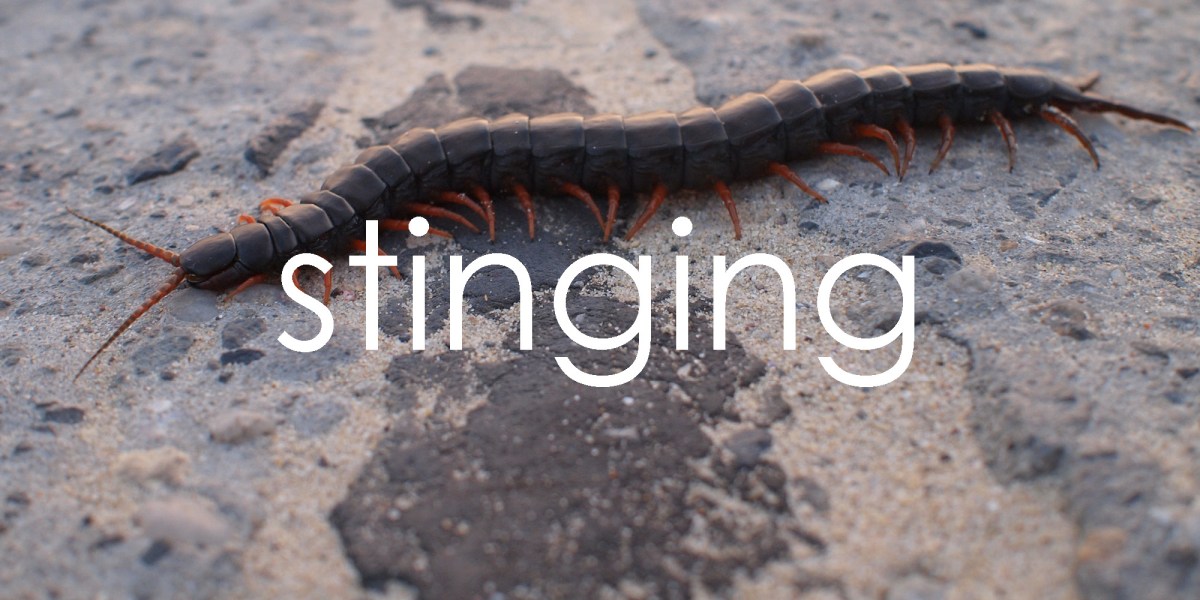
When I was a young boy I was stung by a centipede—stung, or bit or whatever it is that centipedes do. It was like a little shockwave; made my finger swell up and throb.

I didn’t know a centipede could administer something so painful; they can be nasty little creatures, that’s for sure. I’ve never looked at centipedes quite the same way since.

He (or she, how does one know?) was trying to escape off of an ant hill upon which I had put him (or her). Many human boys do such things. Why? Just to see what happens. A little gladiatorial circus.

What happened was that the ants began swarming the centipede: attacking it like a hoard of minions in a Kung Fu movie. They were probably just trying to defend their home. The centipede was fighting for its life; writhing and stinging and contorting itself in a desperate attempt to escape the onslaught. And he (or she) succeeded and began scrambling away across the sidewalk.

That’s when little boy me reached down and swept the centipede back onto the ant pile. And that’s when the centipede stung me—or bit me, like I said I’m not sure which is the right term. It hurt so much! But still I sat and watched as the ants, this time, successfully overwhelmed and killed the fierce little bug.

I’ve never looked at a centipede in quite the same way since.

Advent IV | Wonder

 If there is one word which most of us would like to significantly reduce from our usage, it must be “like.” I used it twice in that opening sentence.

This word would relegate our lives to simile; serving as a membrane between our sensory and spiritual participation in a textured existence. It may reduce chaffing, but it also blunts our humanness. Our lives were never intended to be similes. It’s like we feel this each time we say like. (The word simile actually means similar, or like.)

Yet Advent presents us with the ineffable—that which cannot be worded. Its the prophets who got most dumbfounded: thrones like jasper, skin like blazing amber, lakes like crystal. Theologians call these beatific  or “blessed” visions—visio beatifica—and they inarticulate (v.) us all. Maybe we use like so much because we’ve forgotten how to be speechless?

Continue reading “Advent IV | Wonder”

Advent III | Joy

Did you know that honeybees dance? They do, and their dance has a name: the waggle dance. But its the reason for their dance which makes this fact truly sublime.

When a worker returns to the hive from a successful pollen reconnaissance, she gathers an audience of other bees around her and does a conspicuous and choreographed series of spins and shakes. “Why?” you ask. The dance is a map. That’s right, this dance—the waggle dance—is the way bees tell one another where to find a bounty. This waggle dance is how bees preserve their colony. They dance for survival.

You might want to watch for yourself. Its so marvelous it may bring you to tears. (Having it narrated by David Attenborough never hurts.) This is the way joy works. It is a map disguised as a dance meant to direct others to bounty.

And the joy of Advent supremely so.

Continue reading “Advent III | Joy”

Advent II | Hope

During elementary school I participated in a reading program that I quite enjoyed. One story has stuck with me all these years later. It brushes up against the topic of hope.

The fable involves a poor man surviving a night on a snowy mountaintop with only his worn peasant garb for warmth. In performing this act, he demonstrates his fortitude to the arrogant village rich man, who justifies his stinginess by attributing poverty to weakness. The rich man—assuming any who attempted such a bivouac would either die or falter—had promised a sizable portion of his wealth to any would-be survivor. Unbeknownst to him, the poor man’s friends had built a large bonfire on neighboring hillside. Though pummeled by the frigid winds, the man gazed intently upon its distant flicker, imagining its warmth to his body. And he survived.

When the poor man appears back in the village the following day, the rich man is incredulous. Upon learning the device of the friends, he declares the prize null—the poor man had violated the rules. Despite protests, the rich man refuses to honor his promise. “The sight of fire was sufficient,” he insists.

The friends again devise a scheme. After a religious fast, the entire village is gathered to a ceremonial feast in the town square. The feast is prepared while the celebrants wait—including the rich man. Scents of broiled meats, herbs, spices, and cakes flood the square. But no food is served. Eventually the rich man becomes impatient and demands the feast begin. He is notified that they would only be allowed to smell the food. Outraged, he rails that smelling can never take the place of eating. In this admission, he loses his prior cause and is forced to honor his promise to the poor man. 

The moral of the fable seems contradictory. Yearning either holds a power that is actual or illusory. In the same way, hope contradicts us thoroughly! Yet, nonetheless, Advent shamelessly invokes it. So we must decide if we will surrender ourselves into its contradictions.  Hope is, at the same time, sublime and ridiculous.

Continue reading “Advent II | Hope”