Gratitude

If you are at all like me, the title of this post caused something like a sinking in your gut. Is it again that time of year where I must be browbeat and chastened over my deficiencies of gratefulness? And, if you’re like me, you’ve long since resigned yourself to these seasonal flagellations as a matter of course. Perhaps a morbid counterweight to the excesses of holiday merriment? If we must.

Must we?

Why are such forced expressions of gratitude so inwardly discordant? What is gratitude anyway, and why is it so hard to simply conjure on demand?

Gratitude is a reflex of the soul; a natural spiritual spontaneity—if you will—for which there is no synthetic. Continue reading “Gratitude”

Vocation | #Friday500

My family watched the movie Mrs. Doubtfire a few weeks ago. It still basically holds up, albeit with it’s share of obligatory yet pointless 90s-era lewd innuendos. Oh well. You may remember the climactic scene where Daniel (played by Robin Williams) books himself simultaneously for a family dinner as Mrs. Doubtfire and a work interview at the same restaurant. What ensues is more uncomfortable than funny and demands the viewer suspend disbelief altogether, as Williams scrambles back and forth changing in and out of drag until his false persona arrives for the interview and, eventually, his true identity is literally unmasked before his estranged wife.

The scene is a forced plot device and is implausible in the extreme, yet it bears an eerie resemblance to our own precarious lives of scramble, in which we careen like pinballs around our days trying to ding all the right bumpers and ramps and kickouts. A constant toggling of personas that oftentimes leaves us feeling on the brink of exposure. At times it may be thrilling, but isn’t it all a little insane? That’s exactly how we can end up feeling—insane! Detached from self, we paddle ourselves around the world trying to rack up scores on some arbitrary machine.

Somewhere in all the cacophony we’re making a simple, unspoken inquiry: “What am I doing here?” More than anything it’s a yelp borne from the pangs of our finitude distended into an infinite abyss of needs and demands.

Our ache is for a sense calling, or, to use the Latinized term, “vocation.”  Continue reading “Vocation | #Friday500”

Victims | #Friday500

My wife and I were leaving a restaurant a couple nights ago with an old friend who was visiting from out of town. He’s a wonderful guy, and also, let’s call it, idiosyncratic! He’ll engage those around him with a quirky ease that verges on unease, but is also keenly aware—alert!—even as he feigns befuddledness. He’s one of a kind.

We walked out of the restaurant and were saying our farewells, when a homeless man approached us. His name was Scottie (but most people call him “Scott”). He was gregarious and unabashed, as typifies a certain such persona, and launched into his rehearsed monologue. It was a poetic and rhythmic biopic-cum-confession, each line punctuated with the phrase, “… I said it was his fault, his fault, her fault!” He would motion in turn to my friend, my wife and me during each run through. It was a dirge for a youth spent blaming the world for his all his problems, but he inverted it in the final stanza to frame his new, awakened recognition that it’s not “his fault, his fault, her fault—but my fault!” slapping his hand on his chest. It ended with the moral that he was now taking total responsibility for his life. That all the problems in his life were his fault.

My friend warmly thanked him, and reached for his wallet. Then he hesitated, put his arm on the man’s shoulder and said, “you know, sometimes it’s not your fault. Sometimes it is another person’s fault.” He then handed him a few dollars. The homeless man expressed his gratitude and moved down the street.

We finished our goodbyes, and my wife and I walked across the street. I started chuckling to myself. My wife told me to stop. “It looks like you’re laughing at that guy.” I couldn’t help myself though. It was such a typical moment for my friend, both wry and truthful and surprisingly present. While I was simply waiting for the conclusion of Scottie’s schtick, my friend was hearing. And he was right, wasn’t he? That’s why I was chuckling. We all own much fault for the plight of our lives, but that cannot mean we are always at fault.

“… you know, sometimes it’s not your fault.” I smile as I write that; as I remember.

It’s true. And the narrative matters. Continue reading “Victims | #Friday500”

Patriotism | #Friday500

We’re having one of those awkward and passive-aggressive non-conversations these days, aren’t we? The topic is patriotism, and, though it typically inhabits the subtextual dimension of values, it does have a tendency of breaching the surface and inserting itself abruptly into the conversation. That’s what’s happening right now.

It’s an elephant in the room, and, like the fabled Indian elephant, we’re all gathered about it like blind folk insisting our subjective impressions be accepted as authoritative. You know the fable, right? A group of blind travelers happens upon said pachyderm, and each places their hands on one section of the animal then attempt to describe it. But each report seems incompatible with the next! Is it hard or squishy, floppy or firm, rough or smooth? They bicker about whose version should be adopted as definitive. Of course the seeing observer would note that their disagreement stems from their dual debilitations of sightlessness and subjectivity. A perceiving observer, however, would name their real debilitation as obstinance; a puzzling refusal to recognize one’s obvious limitations.

The conceptual real estate of patriotism has always been subject to contentious and conflicting claims of possession. This has situated the idea squarely in a Purgatory of parlance. In colonial-era Britain, the term was a political byword; a means of associating one’s opponent with those whose love of country had cost them their civil instincts. In true American fashion, the byword was playfully co-opted (much like “yankee doodle”) into the revolutionary vernacular.  We were busy starting a new nation, and if they wanted to call us patriots, so be it!

And so patriotism received its coronation into the courts of unwritten American virtues. As such, we’re often loath to concede just how precarious the concept really is, and how, as an unexamined virtue, it might degrade into something foul. Continue reading “Patriotism | #Friday500”

Hurt | #Friday500

There’s an adage that, “hurting people hurt people.” It may ring trite, but I think it also rings true. Aren’t we all hurting people? So how on earth do we keep from hurting people?

A friend recently went through an awful ordeal; nearly lost a loved one; thought he had. A few days later another friend began to ask him about it, and a tempest of emotions burst out, startling even him. He told me later of the memory of the ordeal, “it was like putting my hand on a hot stove every time it came to mind. It was so painful that I couldn’t bear to even think about it.”

But it was there; was it ever still there!

Another friend wrote a piece awhile back about the loss of his dad, exploring the relationship between anger and hurt,

Being angry, people who know tell me, means dealing with your hurt alone.

That really stood out to me. I think it’s true too.

It makes me grieve for what is becoming a nation of lonely hurters—my nation. I can’t get the sounds out of my head, the thump, thump, thump of gunfire hailing down apocalyptic on a crowd in Las Vegas. Or the shrieking of tires followed by a concussive thud of a car throttled (in both uses of that word) into a crowd on the streets of Charlottesville.

The former, a man returning to the site of unresolved pain; the undiscussed arrest and detainment of his bank-robber father when he was only 7. Whisked swiftly off to California, he wouldn’t learn the truth of his father’s demise until his 20s. The latter, a man whose hurt smoldered in a relative isolation breached mostly by a steady fuel of high octane hatred.

There is an eruptive quality to all of this; something almost atomic, which, of course, is the product of something small but central—nuclear—being fractured. And so it is that humans might behave like bombs, or is it the other way around? Continue reading “Hurt | #Friday500”

Balance | #Friday500

Used by permission. Michael Grab (gravityglue.com)A few months back I found myself suddenly beset by vertigo. It was an ordeal with which I would prefer no encore. At worst, the sensation was of constant spinning; an interminable Tilt-A-Whirl with a deranged operator. I could neither stand nor walk, but tottered and tipped my way through each day; bracing against anything and everthing firm. Even the menial required a Herculean effort of focus. Each slight sideways glance set my surroundings into nauseating slosh. By mid-afternoon, I was seasick and exhausted; incapacitated by nightfall. Accompanying these physical debilitations was the troubling uncertainty as to whether this would prove chronic or acute. Was this to become my new normal?

Mercifully, this condition waned and abated, leaving me with a newfound appreciation and awareness of this faculty called balance.

Balance, like many faculties, remains largely unheralded until it goes missing. We might learn to live in imbalance, as with other impairments, but only through compensating collateral exertion. Some cases of vertigo do in fact prove chronic, and the unremittingness of such a state unfamiliarizes those afflicted with experiential wellness while, at the same time, obscuring the toll exacted. We cannot comprehend what imbalance demands of us.

Haven’t so many of us forgotten what it means to be in balance? Continue reading “Balance | #Friday500”

Weight | #Friday500

The Hebrew word for glory is kabowd (כָּבוֹד), but its literal meaning is “weight” or “heaviness”. Of course, we humans are said to have been made for glory—for God’s glory. And this sounds so wonderful, but doesn’t it so often feel like weight—heaviness?

Adulthood catches most of us unawares. The scales suddenly tip; the stuff belonging to others surrenders to that which belongs to me. It’s weighty.

When we were children, clothing was purchased under the assumption of “growing into”; kneeling shoe store clerks prodding tips of Pro Wings, glancing up to indicate between thumb and index the allowance of space. It was silently ritualistic. Mom or dad or grandma nodding or wincing the verdict. Then, one unceremonious day, it stopped. Did the show fit or not? The starkness of that question sobered like cold water; it dizzied like a landed jab. And the adults, for their part, had made themselves scarce. Was this some prosaic right of passage? Yes. Continue reading “Weight | #Friday500”

depression

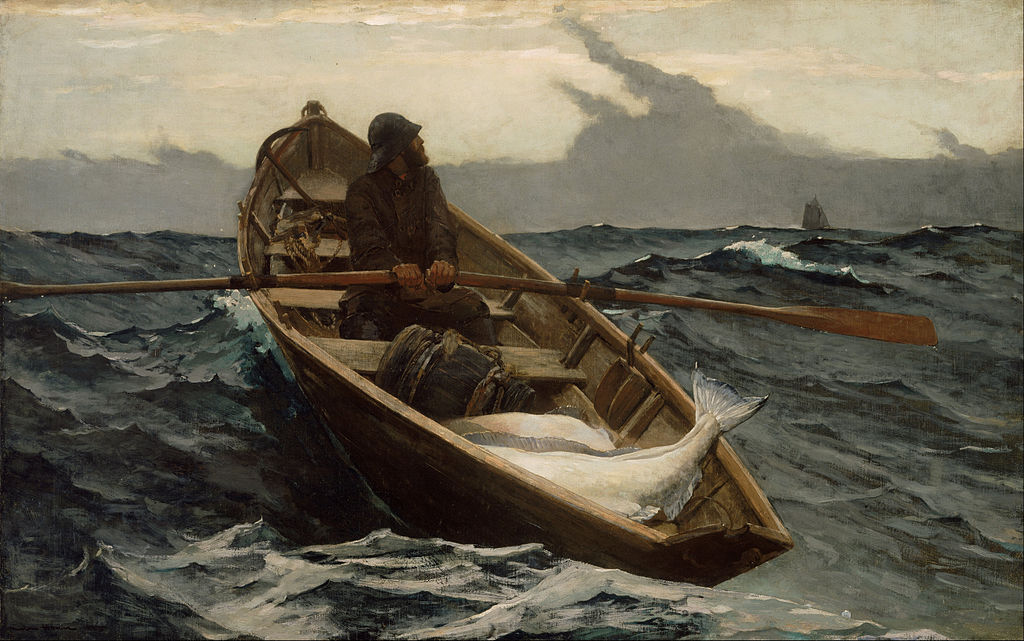
Fog Warning, Winslow Homer (1885)

Fog Warning is likely Winslow Homer’s finest piece. He produced it during a time of living and painting in the late 19th century off the coast of Maine. It tingles with a subtle drama. Portrayed is a solitary fisherman, his small row-boat, heavy with a catch of halibut, crests a wave. He is glancing over his shoulder at the main ship to which he must return. It is still a long ways off. In the distance, the fog is rolling in.

It may appear to be a somber depiction of New England fishing life, but it more dire than that. The 1876 volume The Fisheries of Glouscester records:

His frail boat rides like a shell upon the surface of the sea … a moment of carelessness or inattention, or a slight miscalculation, may cost him his life. And a greater foe than carelessness lies in wait for its prey. The stealthy fog enwraps him in its folds, blinds his vision, cuts off all marks to guide his course, and leaves him afloat in a measureless void.

This fisherman is facing real peril.

Homer keeps the scene unresolved. And I can’t help but see it as a portrayal of depression. Those of us who have experienced depression can relate to this solitary figure. The inner plea, “No. No. No.” Continue reading “depression”

The Human Paradox | #Friday500

On January 19, 2006 NASA launched the New Horizons probe at a departure velocity of 36,000 mph (10 miles per second!). For the next decade it would travel three-quarters of a million miles each day toward an object over 5 billion miles away, which was moving 10,000 mph in an irregular elliptical orbit around the sun—the planet Pluto. The probe whizzed by in July of 2015 and began taking high-resolution photographs of the planet. It needed to slip through a window of space about the size of Delaware, and had only 100 seconds to do so. It did so. It then began broadcasting the images back to earth; a transmission requiring over 16 months of travel until their earthly reception. In October of 2016 the stunning images began arriving.

As it turns out, Pluto bears the marking of a magnificent heart.

In the intervening years, it came to light that Bernard Maddoff had hoodwinked investigators while defrauding investors in his Ponzi scheme to the tune of $18 billion. Fortunes were lost. Lives were lost. Investment banks and bankers gorged themselves on the cannibalistic wealth-structures of mortgage backed securities, before nearly collapsing the American economy during the sub-prime mortage crisis; leaving tax-payers and underwater mortgage-holders shouldering the crushing load. An earthquake struck the impoverished nation of Haiti, and, as a result of sub-standard construction and lack of services, killed nearly 200,000 people. Between 2010 and 2012, almost 300,000 people (10% of children under 5 years of age) died because of famine in Somalia. Both catastrophes, among innumerable others, would have been fractional in scope if not for an unimaginable inequality produced by an unconscionable hoarding of global resources. During this decade, the richest 1% went from holding 40% to over 50% of our world’s wealth.

This is the human paradox. That humans are a species apart, this is undeniable. Yet what is also undeniable is that something is terribly wrong. A race that is capable of almost anything, tends overwhelmingly to utilize their incalculable powers for brutality over beauty. Unlike Pluto, we do not bear the markings of a magnificent heart. Continue reading “The Human Paradox | #Friday500”

Chicago | Carl Sandburg

Like many great authors, Carl Sandburg’s formative years were multifarious in quality. Born in 1878 in Galesburg, IL (his name was originally spelled -berg), he lived and worked in Kansas, Colorado, Nebraska and, of course, Chicago.

Sandburg wrote for the Chicago Daily News, but was known as a prolific folk singer-songwriter, Lincoln biographer and, above all, poet.

He never graduated from college, but won three Pulitzer Prizes (2 for poetry and 1 for his biography of Lincoln).

He died in 1967 in North Carolina at the age of 89.

It was he who coined the Chicago moniker “City of Broad Shoulders”, although his actual phrasing was “city of big shoulders”. It describes the persona of the city, which Sandburg personifies in this layered celebration of his adopted home.

Enjoy!

CHICAGO

by Carl Sandburg

Hog Butcher for the World,
   Tool Maker, Stacker of Wheat,
   Player with Railroads and the Nation’s Freight Handler;
   Stormy, husky, brawling,
   City of the Big Shoulders:
They tell me you are wicked and I believe them, for I have seen your painted women under the gas lamps luring the farm boys.
And they tell me you are crooked and I answer: Yes, it is true I have seen the gunman kill and go free to kill again.
And they tell me you are brutal and my reply is: On the faces of women and children I have seen the marks of wanton hunger.
And having answered so I turn once more to those who sneer at this my city, and I give them back the sneer and say to them:
Come and show me another city with lifted head singing so proud to be alive and coarse and strong and cunning.
Flinging magnetic curses amid the toil of piling job on job, here is a tall bold slugger set vivid against the little soft cities;
Fierce as a dog with tongue lapping for action, cunning as a savage pitted against the wilderness,
   Bareheaded,
   Shoveling,
   Wrecking,
   Planning,
   Building, breaking, rebuilding,
Under the smoke, dust all over his mouth, laughing with white teeth,
Under the terrible burden of destiny laughing as a young man laughs,
Laughing even as an ignorant fighter laughs who has never lost a battle,
Bragging and laughing that under his wrist is the pulse, and under his ribs the heart of the people,
                   Laughing!
Laughing the stormy, husky, brawling laughter of Youth, half-naked, sweating, proud to be Hog Butcher, Tool Maker, Stacker of Wheat, Player with Railroads and Freight Handler to the Nation.