Racism II: Defined | #Friday500

[This is post is part of a five-part series. You can find a link to all five here.]

Let’s just cut to the chase, shall we? Whites mean something different than non-whites when they use the term “racism.” This effectively stalls one of the most needed of national conversations on the topic of race, because our semantics on the pivotal word are incongruent.

I’m going to use the terms “white” and “non-white” in a broad sort of way here. Firstly, I really mean most whites (the generality of the white community) and most non-whites. Secondly, blacks and indigenous Americans have the most direct and tragic history with the concept of race and racism in our nation, but the carryover onto every community of color has been enfolded into our nation’s cruelest legacy.

And while a mutually-understood employment of the term “racism” is critical toward any meaningful dialogue, it must be said up front: whites are wrong on this, and non-whites are right. Continue reading “Racism II: Defined | #Friday500”
Racism I: Race | #Friday500

[This is post is part of a five-part series. You can find a link to all five here.]

There’s a very important but under-talked-about topic in our country, and it has to do with vocabulary of race and racism. Specifically, the incongruence between the usage and understanding of these terms between most white and non-white communities.

We need to be having an important national conversation about race, but the incongruence of our vocabularies render this virtually impossible.

As with all conversations, meaning is irreducibly critical. When meaning is not mutually shared or at least understood, dialogue will always degenerate.

Whites and non-whites mean different things by the word racism, and until this gets more broadly sorted out communication on the topic is fraught with discord. This crops up so often in main stream media and everyday conversations, that I can’t believe it isn’t constantly being clarified! It’s one of the least addressed semantic landmines out there.

Flannery O’Conner once said:

I write because I don’t know what I think until I read what I say.

I’ve tried to be pretty forthright that the things I’ve been posting are, in part, my own efforts to write in such a way as to “know what I think.” This topic may be the truest example of this, because, full disclosure, I myself had no awareness of this semantic incongruity until very recently.

My working definition of racism has always resembled this: Treating people differently based on their race.

This is the way whites commonly define racism: personal or situational incidents in which race becomes a criteria for our treatment—positive or negative—of others.

This is patently not the way a non-white would encapsulate the idea of racism.

But we can’t move this forward until we understand the term “race”.  Continue reading “Racism I: Race | #Friday500”

Sport as Signal

On April 15, 1947 Jackie Robinson played his first Major League game. He started at first base and batted second in the lineup. He scored the winning run that day, but that was only a sheen on what he’d truly achieved; what was being achieved through this 28-year-old man.

Robinson was the first black player permitted to play in the modern Major Leagues.

That was only 70 year ago. Many who were there still live to tell about it.

I really love sports. And I’m always interrogating myself as to what that means—whether it’s a good thing or bad. Sports is really only entertainment, yet it occupies a special cultural space in societies far and wide. It can be an amniocentesis of culture and of the composition of societal values. In this regard, it must be seen as far more than mere entertainment. Continue reading “Sport as Signal”

The Billy Graham Rule

I’m a male. I’m a Christian. I’m a leader. I’m a male Christian leader, and I came of age in the long twilight shadows of “the Billy Graham rule.”

What is the Billy Graham Rule (BGR)? It was one of the principles formulated by the aforementioned traveling evangelist and his associates in 1948 during an outreach event in Modesto, CA. It constituted an effort to preserve their own integrity in the areas of finances, collaboration with churches, event reporting and, most famously, marital fidelity.

They called this document, the “Modesto Manifesto.”  The aspect garnering the most recent notice pertains to parameters regarding interaction with those of the opposite sex (in their case, females):

We all knew of evangelists who had fallen into immorality while separated from their families by travel. We pledged among ourselves to avoid any situation that would have even the appearance of compromise or suspicion. From that day on, I did not travel, meet or eat alone with a woman other than my wife.

This rule has been thrust unexpectedly into the national conversation after it was revealed that Vice President Mike Pence himself subscribes to an iteration of it.

This tempest in a teapot has up-swelled a veritable pandemonium of responses! (Just Google “Billy Graham Rule.”) Commentators have scrutinized this principle from every conceivable angle; defending, ridiculing, questioning its legality and even conflating it with misogyny and the promotion of “rape culture”—met in turn with recriminating charges of hypocrisy!

Personally, this has occasioned the opportunity for me to reflect on my own history with this rule. I’ll share it with you here.

Continue reading “The Billy Graham Rule”

Truth | #Friday500

I went to bed on Saturday thinking about the topic of truth; truth, truth, what needs to be said about truth? 

I’d already cued up my Monday Emily Dickinson post:

Too bright for our infirm Delight
The Truth’s superb surprise

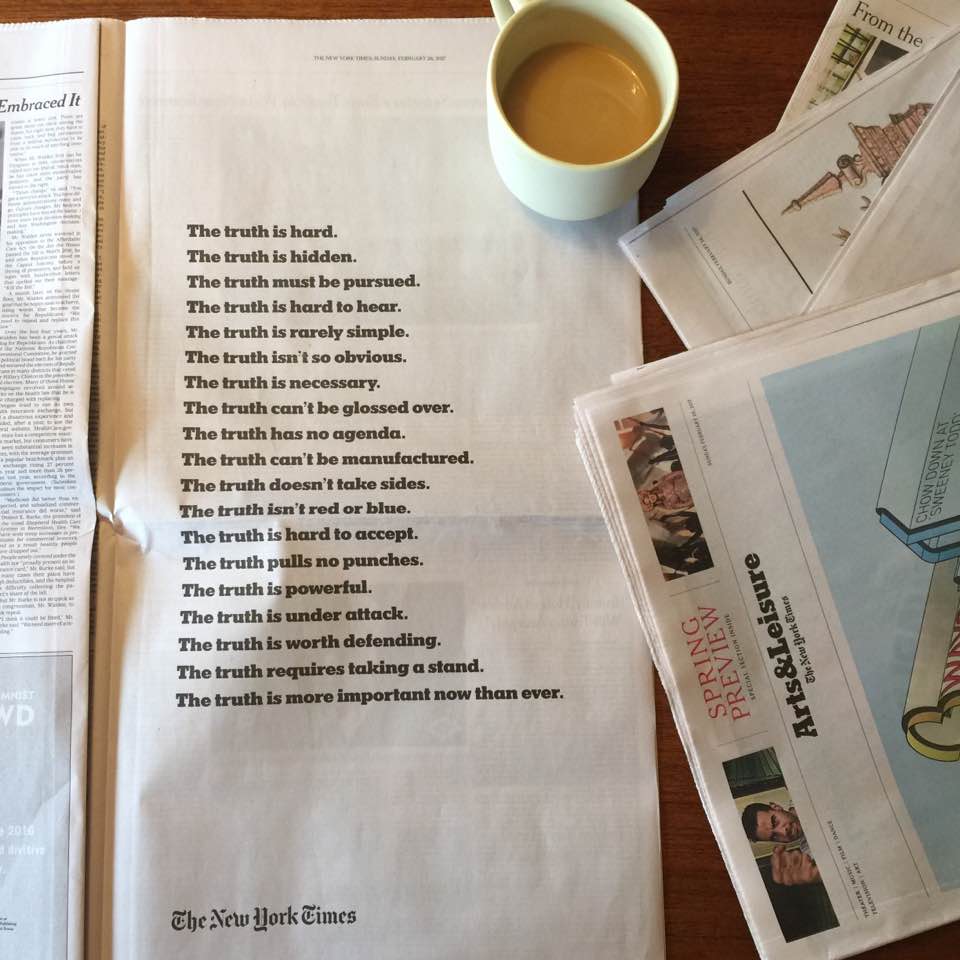
I awoke the next morning to see a picture my friend had posted of the New York Times full page truth ad; accompanied that night by an unprecedented (sp?) TV spot during the Oscars.

I’m not alone! I thought.

As I mentioned in my meta post, the human assignment of life is (to quote Viktor Frankl), “…taking the responsibility to find the right answer to its problems and to fulfill the tasks which it constantly sets for each individual.”

The human assignment is to discover and live in congruence with truth, and, while this is incumbent upon each individual, it is most successfully completed among company. And this is what makes deceit so unnerving, is it not? It makes this assignment an unbearably lonely affair, fraught with risk, threat and painful betrayal; a hopeless, nihilistic errand.

Truth, while absolute and objective, is always arrived at through very subjective processes; what the philosophers call epistemologyLike bats, we echolocate ourselves in a world of darkness, trusting in a dynamic matrix of feedbacks; hoping (needing?) to find them reliable!

This, I sense, was the tenor of the New York Times ad. Truth has no agenda; it simply is. And, like the obstinate, arrogant ship captain insisting an oncoming vessel change course, until alerted that what he’d presumed was a vessel is actually a lighthouse, so too we all must accept that truth is no respecter of power or pride or even position. Continue reading “Truth | #Friday500”

Politics | #Friday500

When Facebook first came into existence we were—each of us—required to create a profile. As I recollect, it was displayed fairly prominently. We entered data like: name, birthday, religion and political beliefs.

I remember thinking about that last one a lot (probably too much). Initially, I opted for the term apolitical, because I wasn’t keen on needlessly pegging myself to a political ideology.

Later I landed on a quote by the eminent Gregory Jacobs (AKA Shock G AKA Humpty Hump):

Hypothetical, political, lyrical, miracle whip

And here, all these years later, I think I made the right choice. 1 Continue reading “Politics | #Friday500”

Desperation | #Friday500

In his seminal book NightElie Wiesel recounts a horrifying event among a trainload of starving Jews locked in a train to Buchenwald. The Nazi guards throw food into the cars, and gawk while the prisoners fight to the death. A son kills his own father over a piece of bread.

I will never forget reading that. It is an excruciating glimpse into the human condition degraded by desperation. Of course it is an instance of violence, but one could hardly fault those who were deranged by deprivation.

Dietrich Bonhoeffer’s Ethics was largely born from his own labors to faithfully live his Christian faith in fascist Nazi society. In it he writes of abortion calling it, “nothing but murder.” (In modern terms, he’d be described as “pro-life”.) However, training the focus on the issue of responsibility or culpability, he continues:

“… in cases where it is an act of despair, performed in circumstances of extreme human or economic destitution and misery, the guilt may often lie rather with the community than with the individual.”

I’m not intending to address the issue of abortion here, but rather draw attention to Bonhoeffer’s application of guilt. In essence, he says that a woman’s society bears the blame for her choice made in despair and destitution.

We don’t often think of ethics that way—we want to situate blame on individuals. This is very Western, and is actually incongruent with the collective ethics of Scripture.  Continue reading “Desperation | #Friday500”

Violence | #Friday500

I live on the Southside of Chicago, and my city has become a placeholder for the topic of gun violence. Last year (2016) there were more than 700 homicides–over 4000 shooting victims. Just writing those numbers makes me feel heavy with grief.

Of course, this isn’t just a Chicago problem. Per capita, places like New Orleans, Detroit, Baltimore and St Louis have 2-3x higher murder rates than our city.

It’s not a morbid competition, but when our president takes the issue to Twitter it begs so many questions.

Continue reading “Violence | #Friday500”