Patriotism | #Friday500

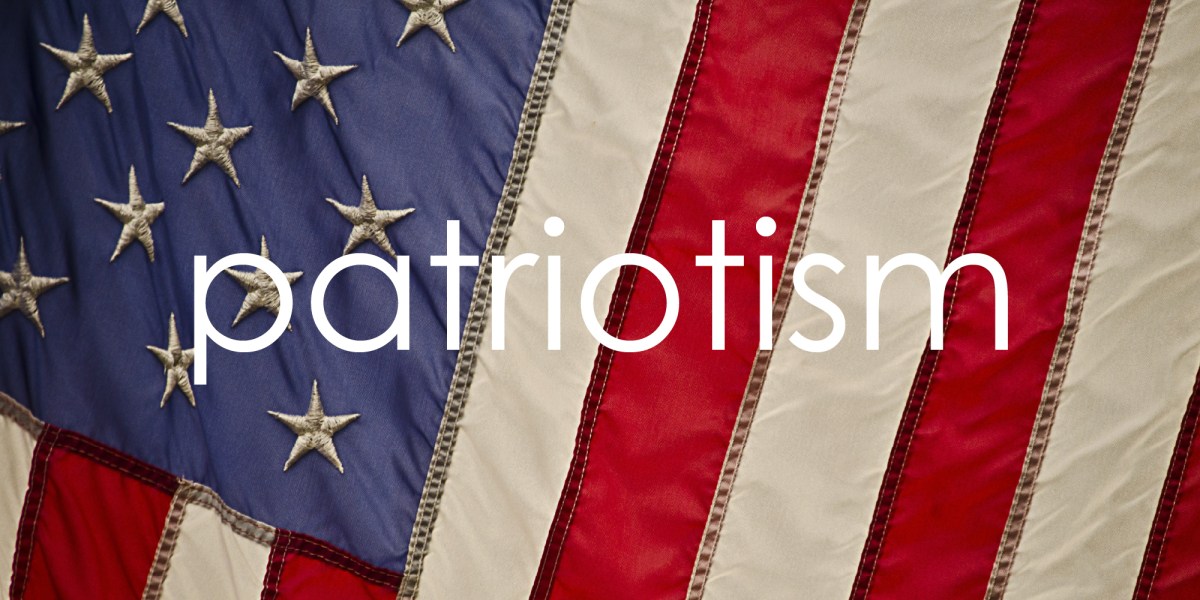
We’re having one of those awkward and passive-aggressive non-conversations these days, aren’t we? The topic is patriotism, and, though it typically inhabits the subtextual dimension of values, it does have a tendency of breaching the surface and inserting itself abruptly into the conversation. That’s what’s happening right now.

It’s an elephant in the room, and, like the fabled Indian elephant, we’re all gathered about it like blind folk insisting our subjective impressions be accepted as authoritative. You know the fable, right? A group of blind travelers happens upon said pachyderm, and each places their hands on one section of the animal then attempt to describe it. But each report seems incompatible with the next! Is it hard or squishy, floppy or firm, rough or smooth? They bicker about whose version should be adopted as definitive. Of course the seeing observer would note that their disagreement stems from their dual debilitations of sightlessness and subjectivity. A perceiving observer, however, would name their real debilitation as obstinance; a puzzling refusal to recognize one’s obvious limitations.

The conceptual real estate of patriotism has always been subject to contentious and conflicting claims of possession. This has situated the idea squarely in a Purgatory of parlance. In colonial-era Britain, the term was a political byword; a means of associating one’s opponent with those whose love of country had cost them their civil instincts. In true American fashion, the byword was playfully co-opted (much like “yankee doodle”) into the revolutionary vernacular.  We were busy starting a new nation, and if they wanted to call us patriots, so be it!

And so patriotism received its coronation into the courts of unwritten American virtues. As such, we’re often loath to concede just how precarious the concept really is, and how, as an unexamined virtue, it might degrade into something foul. Continue reading “Patriotism | #Friday500”

Hurt | #Friday500

There’s an adage that, “hurting people hurt people.” It may ring trite, but I think it also rings true. Aren’t we all hurting people? So how on earth do we keep from hurting people?

A friend recently went through an awful ordeal; nearly lost a loved one; thought he had. A few days later another friend began to ask him about it, and a tempest of emotions burst out, startling even him. He told me later of the memory of the ordeal, “it was like putting my hand on a hot stove every time it came to mind. It was so painful that I couldn’t bear to even think about it.”

But it was there; was it ever still there!

Another friend wrote a piece awhile back about the loss of his dad, exploring the relationship between anger and hurt,

Being angry, people who know tell me, means dealing with your hurt alone.

That really stood out to me. I think it’s true too.

It makes me grieve for what is becoming a nation of lonely hurters—my nation. I can’t get the sounds out of my head, the thump, thump, thump of gunfire hailing down apocalyptic on a crowd in Las Vegas. Or the shrieking of tires followed by a concussive thud of a car throttled (in both uses of that word) into a crowd on the streets of Charlottesville.

The former, a man returning to the site of unresolved pain; the undiscussed arrest and detainment of his bank-robber father when he was only 7. Whisked swiftly off to California, he wouldn’t learn the truth of his father’s demise until his 20s. The latter, a man whose hurt smoldered in a relative isolation breached mostly by a steady fuel of high octane hatred.

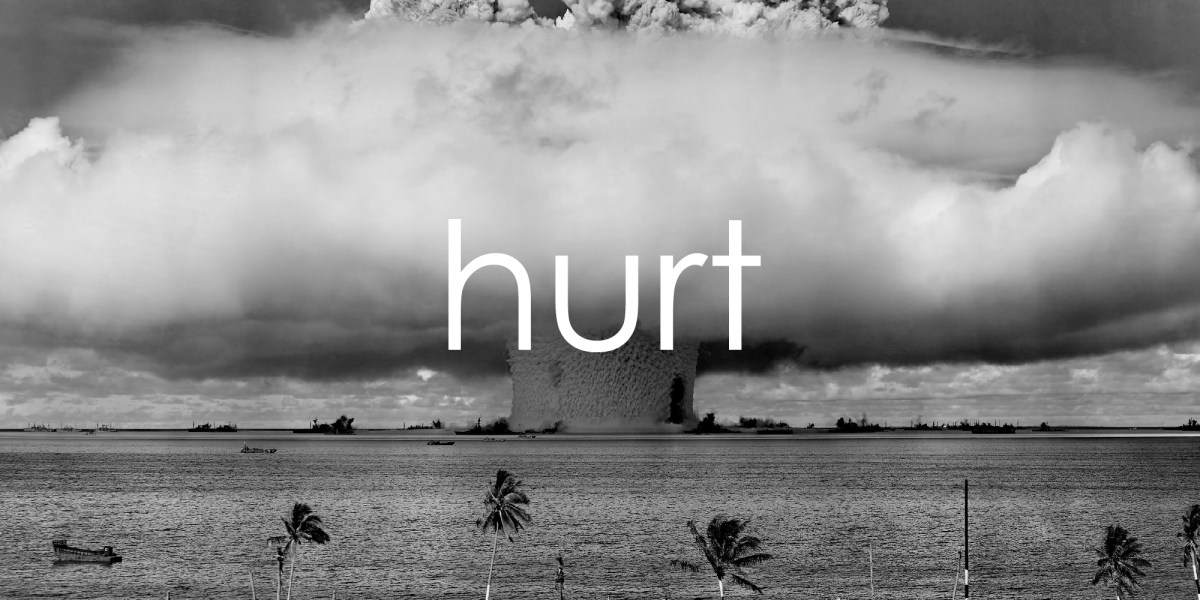
There is an eruptive quality to all of this; something almost atomic, which, of course, is the product of something small but central—nuclear—being fractured. And so it is that humans might behave like bombs, or is it the other way around? Continue reading “Hurt | #Friday500”

Balance | #Friday500

Used by permission. Michael Grab (gravityglue.com)A few months back I found myself suddenly beset by vertigo. It was an ordeal with which I would prefer no encore. At worst, the sensation was of constant spinning; an interminable Tilt-A-Whirl with a deranged operator. I could neither stand nor walk, but tottered and tipped my way through each day; bracing against anything and everthing firm. Even the menial required a Herculean effort of focus. Each slight sideways glance set my surroundings into nauseating slosh. By mid-afternoon, I was seasick and exhausted; incapacitated by nightfall. Accompanying these physical debilitations was the troubling uncertainty as to whether this would prove chronic or acute. Was this to become my new normal?

Mercifully, this condition waned and abated, leaving me with a newfound appreciation and awareness of this faculty called balance.

Balance, like many faculties, remains largely unheralded until it goes missing. We might learn to live in imbalance, as with other impairments, but only through compensating collateral exertion. Some cases of vertigo do in fact prove chronic, and the unremittingness of such a state unfamiliarizes those afflicted with experiential wellness while, at the same time, obscuring the toll exacted. We cannot comprehend what imbalance demands of us.

Haven’t so many of us forgotten what it means to be in balance? Continue reading “Balance | #Friday500”

Weight | #Friday500

The Hebrew word for glory is kabowd (כָּבוֹד), but its literal meaning is “weight” or “heaviness”. Of course, we humans are said to have been made for glory—for God’s glory. And this sounds so wonderful, but doesn’t it so often feel like weight—heaviness?

Adulthood catches most of us unawares. The scales suddenly tip; the stuff belonging to others surrenders to that which belongs to me. It’s weighty.

When we were children, clothing was purchased under the assumption of “growing into”; kneeling shoe store clerks prodding tips of Pro Wings, glancing up to indicate between thumb and index the allowance of space. It was silently ritualistic. Mom or dad or grandma nodding or wincing the verdict. Then, one unceremonious day, it stopped. Did the show fit or not? The starkness of that question sobered like cold water; it dizzied like a landed jab. And the adults, for their part, had made themselves scarce. Was this some prosaic right of passage? Yes. Continue reading “Weight | #Friday500”

depression

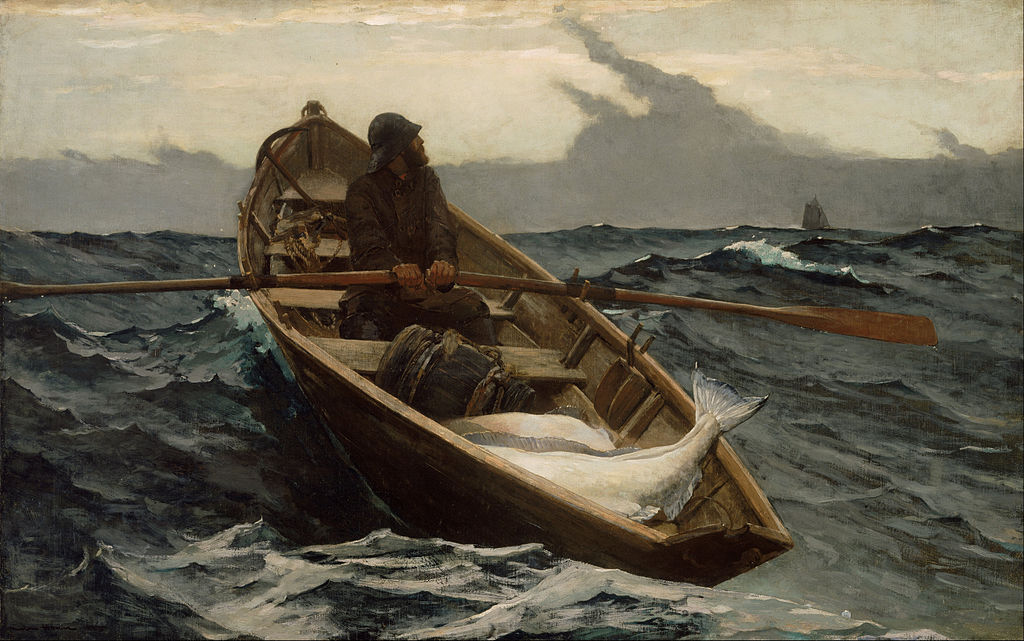
Fog Warning, Winslow Homer (1885)

Fog Warning is likely Winslow Homer’s finest piece. He produced it during a time of living and painting in the late 19th century off the coast of Maine. It tingles with a subtle drama. Portrayed is a solitary fisherman, his small row-boat, heavy with a catch of halibut, crests a wave. He is glancing over his shoulder at the main ship to which he must return. It is still a long ways off. In the distance, the fog is rolling in.

It may appear to be a somber depiction of New England fishing life, but it more dire than that. The 1876 volume The Fisheries of Glouscester records:

His frail boat rides like a shell upon the surface of the sea … a moment of carelessness or inattention, or a slight miscalculation, may cost him his life. And a greater foe than carelessness lies in wait for its prey. The stealthy fog enwraps him in its folds, blinds his vision, cuts off all marks to guide his course, and leaves him afloat in a measureless void.

This fisherman is facing real peril.

Homer keeps the scene unresolved. And I can’t help but see it as a portrayal of depression. Those of us who have experienced depression can relate to this solitary figure. The inner plea, “No. No. No.” Continue reading “depression”

The Human Paradox | #Friday500

On January 19, 2006 NASA launched the New Horizons probe at a departure velocity of 36,000 mph (10 miles per second!). For the next decade it would travel three-quarters of a million miles each day toward an object over 5 billion miles away, which was moving 10,000 mph in an irregular elliptical orbit around the sun—the planet Pluto. The probe whizzed by in July of 2015 and began taking high-resolution photographs of the planet. It needed to slip through a window of space about the size of Delaware, and had only 100 seconds to do so. It did so. It then began broadcasting the images back to earth; a transmission requiring over 16 months of travel until their earthly reception. In October of 2016 the stunning images began arriving.

As it turns out, Pluto bears the marking of a magnificent heart.

In the intervening years, it came to light that Bernard Maddoff had hoodwinked investigators while defrauding investors in his Ponzi scheme to the tune of $18 billion. Fortunes were lost. Lives were lost. Investment banks and bankers gorged themselves on the cannibalistic wealth-structures of mortgage backed securities, before nearly collapsing the American economy during the sub-prime mortage crisis; leaving tax-payers and underwater mortgage-holders shouldering the crushing load. An earthquake struck the impoverished nation of Haiti, and, as a result of sub-standard construction and lack of services, killed nearly 200,000 people. Between 2010 and 2012, almost 300,000 people (10% of children under 5 years of age) died because of famine in Somalia. Both catastrophes, among innumerable others, would have been fractional in scope if not for an unimaginable inequality produced by an unconscionable hoarding of global resources. During this decade, the richest 1% went from holding 40% to over 50% of our world’s wealth.

This is the human paradox. That humans are a species apart, this is undeniable. Yet what is also undeniable is that something is terribly wrong. A race that is capable of almost anything, tends overwhelmingly to utilize their incalculable powers for brutality over beauty. Unlike Pluto, we do not bear the markings of a magnificent heart. Continue reading “The Human Paradox | #Friday500”

Chicago | Carl Sandburg

Like many great authors, Carl Sandburg’s formative years were multifarious in quality. Born in 1878 in Galesburg, IL (his name was originally spelled -berg), he lived and worked in Kansas, Colorado, Nebraska and, of course, Chicago.

Sandburg wrote for the Chicago Daily News, but was known as a prolific folk singer-songwriter, Lincoln biographer and, above all, poet.

He never graduated from college, but won three Pulitzer Prizes (2 for poetry and 1 for his biography of Lincoln).

He died in 1967 in North Carolina at the age of 89.

It was he who coined the Chicago moniker “City of Broad Shoulders”, although his actual phrasing was “city of big shoulders”. It describes the persona of the city, which Sandburg personifies in this layered celebration of his adopted home.

Enjoy!

CHICAGO

by Carl Sandburg

Hog Butcher for the World,
   Tool Maker, Stacker of Wheat,
   Player with Railroads and the Nation’s Freight Handler;
   Stormy, husky, brawling,
   City of the Big Shoulders:
They tell me you are wicked and I believe them, for I have seen your painted women under the gas lamps luring the farm boys.
And they tell me you are crooked and I answer: Yes, it is true I have seen the gunman kill and go free to kill again.
And they tell me you are brutal and my reply is: On the faces of women and children I have seen the marks of wanton hunger.
And having answered so I turn once more to those who sneer at this my city, and I give them back the sneer and say to them:
Come and show me another city with lifted head singing so proud to be alive and coarse and strong and cunning.
Flinging magnetic curses amid the toil of piling job on job, here is a tall bold slugger set vivid against the little soft cities;
Fierce as a dog with tongue lapping for action, cunning as a savage pitted against the wilderness,
   Bareheaded,
   Shoveling,
   Wrecking,
   Planning,
   Building, breaking, rebuilding,
Under the smoke, dust all over his mouth, laughing with white teeth,
Under the terrible burden of destiny laughing as a young man laughs,
Laughing even as an ignorant fighter laughs who has never lost a battle,
Bragging and laughing that under his wrist is the pulse, and under his ribs the heart of the people,
                   Laughing!
Laughing the stormy, husky, brawling laughter of Youth, half-naked, sweating, proud to be Hog Butcher, Tool Maker, Stacker of Wheat, Player with Railroads and Freight Handler to the Nation.

Naming | #Friday500

I’ve recently discovered myself to be a fairly poor runner. I’m consistently inconsistent, and can scarcely muster 2 miles. I know. But on those rare and rough occasions when I strap on the sneakers, I always run past the above statue. Perched on a pedestal amidst a calmingly manicured wooded parcel, it gazes out over the “Midway Plaisance“—a stretch of green space that runs along the south section of the University of Chicago. It was originally a convention space for the 1893 World’s Fair; the site of the first ever ferris wheel.

Plaisance is a French word, which appropriately means, “pleasantness”.

It contains a cryptic plaque emblazoned only with “Linné”. During one such run, I determined to solve the mystery. I learned its likeness to be that of 18th century Swedish botanist, zoologist and physician Carl von Linné, considered the Father of Taxonomy; viz., naming organisms. He devised our modern binomial i.e. genus, species).

Linné wrote:

The closer we get to know the creatures around us, the clearer is the understanding we obtain of the chain of nature, and its harmony and system, according to which all things appear to have been created.

Naming is a uniquely human activity; a component of what evolutionary biologist have coined niche construction—the way organisms shape their environment. Naming is a form of ordering and understanding, and it carries a power we are prone to under-appreciate—the power of definition. Continue reading “Naming | #Friday500”

For Your Consideration (06/28/17)

A GOOD WALK SPOILED

Mark Twain once referred to the game of golf as, “A good walk, spoiled.”

I tend to agree. I suspect the enduring resonance of the quote demonstrates it to be a commonly held sentiment.

In truth, I’ve had a similar sentiment toward Malcolm Gladwell material—an under-gratifying expenditure of time. You know Malcom Gladwell! He wrote David and Goliath and The Tipping Point. His main schtick revolves around a certain manufactured eureka. (He’s been accused of being reductionistic. Oftentimes he strikes me as a bit pedantic.)

Still, I’m coming around. (Not to golf, but to Malcom Gladwell.) I’m coming to appreciate his doggedly egalitarian bias, and his willingness to question societal and institutional status quo. (There is no agreement on the plural for that latin phrase, I’ve found.)

Gladwell has just begun season 2 of his podcast Revisionist History, which I’ve come to enjoy. Episode 1 probes the the absurdity of golf, specifically private golf courses in Los Angeles and the unconscionable subsidies they enjoy from a city devoid of adequate public parks.

He does a good job of this.

You should listen if for no other reason than to be exposed to The Ship of Theseus (or Theseus’ Paradox), and the comparison of mereological vs spatiotemporal theories on identity. Think, “Why does the Hudson River remain the Hudson River even though it is constantly composed of different water particles?” How might this same paradox be applied to rich white men?

FIRING FROM FEAR

Many were distraught this week after a jury acquitted Minneapolis-area police officer Jeronimo Yanez in the shooting death of motorist Philando Castile. I was also distraught.

Days later the dash-cam video was released. It is hard to watch. It is also hard to fathom how this was found to be anything but a criminal use of deadly force.

David French of The National Review penned a strong piece on the unwritten law equating fear with innocence in most police-involved shootings.

It’s imperative that juries understand that not all fear is reasonable, and some officers simply and wrongly panic…

When I saw that palpable panic, I immediately knew why he was acquitted. The unwritten law trumped the statutes on the books. The unwritten law is simple: When an officer is afraid, he’s permitted to shoot. Juries tend to believe that proof of fear equals proof of innocence.

He goes on to give other examples of this unwritten code, but asserts that juries must learn to differentiate between reasonable fear and reckless panic.

Absent corruption, incompetence, or malice, most officers are going to make reasonable choices in high-stress situations.

Some, however, will fail, and it’s imperative that juries understand that not all fear is reasonable, and some officers simply (and wrongly) panic. Perhaps some have unreasonable fear because of racial stereotypes. Perhaps some have unreasonable fears for other reasons. Perhaps some have a brutal habit of escalating force too quickly. But every officer must uphold the rule of reason, a rule that compels a degree of courage, a measure of discipline, and a tolerance for risk that is inherent in the job that they’ve chosen.

The vast majority of officers are up to that challenge. A few are not. They must be held accountable. Justice demands no less.

I would encourage you to read this, and to refine your own views on what must be expected of our police in order for them to not operate de facto above the law. Our nation is to be a place of law and justice. Police cannot operate outside of this, nor can our criminal justice system fail to offer meaningful accountability in those cases when they themselves violently violate those laws they are hired to uphold.

Once you finish that.

CONFRONTING THE MYTH OF POST-RACIAL AMERICA

American University (DC) history professor and author Ibram X. Kendi wrote an OpEd for New York Times on how our police-involved shootings (and the narratives we employ to explain them) expose whether we will hold a truthful or mythical opinion of our country; and that such race-based instances of violence always have.

He writes:

Black people were violent, not the slaveholder, not the lyncher, not the cop. Many Americans are still echoing that argument today.

This blaming of the black victim stands in the way of change that might prevent more victims of violent policing in the future. Could it be that some Americans would rather black people die than their perceptions of America?

It was probably the best piece I read on the Yanez verdict, and its aftermath.

I do not dislike America. But the widespread refusal to truthfully appraise our country is actually at odds with what we claim America to be; the myth is standing in the way of bringing to reality forward toward its aspirations! But, in the meantime, the human and social to toll is grievous to say the least.

The deeper answer is that black death matters. It matters to the life of America, by which I mean the blood flow of ideas that give life to Americans’ perceptions of their nation.

In these high-profile cases, it is not just police officers who are on trial. America is on trial. Either these deaths are justified, and therefore America is just, or these deaths are unjustified, and America is unjust.

I can relate to this felt need to see America as somehow better than it is. I want us to be the good guys! But I can also readily admit that this is too simplistic of a version. I must love truth more than untruth, even if that means loving something ugly over something fake-but-pretty. As a Christian, I actually think this is a key tenant of our profession of faith.

BEFORE THE INTERNET

On a much (much!) lighter note, my wife and I found ourselves smiling and nodding as we read Emma Rathbone‘s meandering anecdotal article for The New Yorker.

Each vignette is led with the phrase, “Before the internet…”

You’d be in some kind of arts center, wearing roomy overalls, looking at a tray of precious gems, and you’d say, “That’s cat’s-eye,” and your friend would say, “Nope. That’s opal.” And you’d say, “That’s definitely cat’s-eye.” And there would be no way to look it up, no way to prove who was right, except if someone had a little booklet. “Anyone got a little booklet?” you’d ask, looking around. “Is there a booklet on this shit?”

Then you’d walk outside and squint at the sky, just you in your body, not tethered to any network, adrift by yourself in a world of strangers in the sunlight.

Kinda true, right? Remember?

Before the Internet, you could laze around on a park bench in Chicago reading some Dean Koontz, and that would be a legit thing to do and no one would ever know you had done it unless you told them.

Go read it. C’mon. It’s short. Probably should have been longer. But it’s short and sweet and on the internet, so.

Speaking of the internet.

SOCIAL CURATE

I like these little info vids from Vox. After you watch this, I’d be curious if any of you would diagnose me with ADHD? If so, should I keep treating it with coffee or pills or nothing at all? I’m open to suggestions!
Racism Series |#Friday500

Lately I’ve been reading, thinking and writing on the topic of race. Many have been so kind as to join me in this important conversation. Some have mentioned these posts to be helpful. In light of this, I am providing links to the entire series below, along with some excerpts from each.

Hoping these might serve you as you bring this needed dialogue into your own spaces.

RACISM I | RACE

But we can’t move this forward until we understand the term “race”.

Put briefly, there’s no such thing as race! The only thing that makes race a thing is that it has been socially engineered to be so. Race is a quasi-scientific category; a category that was invented for socio-cultural reasons, but has been met with repeated failure in its attempts to be “science-ized” in order to support the social construct.

This was observable in the middle of the last century in Nazi Germany, and their promotion of the idea of a superior Aryan race—an idea with roots in the 1850s. Nazi propaganda reflected their unique efforts to demonstrate Nordic racial superiority through pseudo-science. We recoil at these notions, but then forget to interrogate our own understanding of race. Nazi racial ideology is rooted in the racial constructs of Western, white civilization going back into the 1400s.

Now I’m sure that some of you reading are, at this point, so certain that race is a fixed aspect of humanity, that you are questioning the very notion of it having social origins; as though I am telling you that the elements of the Periodic Table are only a social construct.

But race, as we know it, is a superficiality that has been co-opted into Western thinking with a dehumanizing intent. Yes, intent!

RACISM II | DEFINED

And while a mutually-understood employment of the term “racism” is critical toward any meaningful dialogue, it must be said up front: whites are wrong on this, and non-whites are right.

My previous post was aimed at clarifying our understanding of race in general; namely, that it doesn’t exist. Race has, however, been conjured into existence as a means of sub-dividing humans in a fashion more akin to species. But why would anyone want to do that?

Race is a pseudo-scientific socially engineered construct for sub-classifying peoples based on superficial physical traits in order to justify sub-human acts of exploitation toward them.

Read that again. If you miss it, the rest of this will be lost on you.

Of course, there are physical traits that characterize people-groups from various regions of our world; skin color, hair color and type, other facial variations. This is undeniable. But this is not race—not as it has been deployed in the history of the West and in our nation!

And the socio-scientific concept of “ethnicity” is categorically valid; involving a multifaceted study of geographical, genealogical, cultural and lingual factors. Ethnicity is a sociological and anthropological category for understanding meaningful features of people-groups. But this is not race! Race it different. Ethnicity is benign. Race is malignant.

The fiction of race is the basis for the fact of racism—a superficial, systematic and societal sub-classification of people for the sake of exploitation.

But this is not how white people define racism.

RACISM III | WHY WRITE ON RACE?

…my trusted non-white friends, colleagues and students all agreed that white voices must remain in the chorus on this topic. I’m understanding the why behind this more and more.

From the earliest days of abolitionism (a movement that arose immediately on the heels of the colonial era and the widespread advent of chattel enslavement), through the Civil War and Civil Rights movement, voices among the white populace have played an irreducible role toward the cause of racial justice. There is a position and venue into which our voice has more purchase, and oftentimes we know the vernacular for playing translator between both sides.

As much as anything though, I’m seeing how silence is a way of retreat. When those of us in the white community can’t or won’t name racism or address its damage, it communicates either tacit endorsement or craven betrayal. Most people of color have spent their lives swimming upstream against racial currents. They’ve become adept at feigning indifference and maintaining poise in the face of it. As uncomfortable as it is for whites like myself to confront these societal dynamics—even calling them “evil” or “unjust”—still those affected by them have no such choice. Measures of healing come when we enter into their sorrows and even anger. And though I’ve never once met a person who readily admits to being a “racist”, still we know racism is alive and well. If my own history can be any indicator, it seeps out despite our best efforts.

Maybe what I’m dancing around right now is my own racism; my willingness to prefer sloppy stereotypes over human considerations, to prefer judgement over understanding, to exclude or insulate, to remain willfully oblivious to how I benefit from racial constructs and willfully loath to consider my obligations toward remedies, my own hidden attitudes of superiority and innate deservedness. Maybe I’m learning how to grapple within and grapple without in these issues—whether I’m brave enough to enter further into the rough terrain of longsuffering involvement. I can, after all, still use my racial identity as exemption from all this.

But how can I do so, now that I grasp that this is the wrong thing to do?

RACISM IV | PRIVILEGE

Privilege is a good word, not a bad one. Its connotations overwhelmingly positive; fortified with the soul-nourishing nutrients of gratitude, humility, contentment and purpose. For instance, I am privileged to be a husband and father, privileged to be employed, privileged to be in good health. For all this, I feel blessed. Who am I to come into such bounty?

The recognition of privilege appreciates that we have been beneficiaries of forces external to ourselves; outside our powers of control. Privilege is the foil of entitlement, redirecting our attention to endowments, causing us to treasure them.

Yes, privilege has the power to animate those human faculties of kindness, responsibility, compassion and magnanimity which deploy us into the world as life-givers. Yet it carries with it an existential threat; like a conceptual Trojan horse, it might occasion the overthrow of our sense of personal credit—if permitted past our gates of defense.

You see, external credit—especially beyond one’s agency—is a diminution of self-credit, and undeserved prosperity is anathema to the American ethos, is it not? And so we come to privilege not entirely under amicable terms; it is more of a truce. “I will acknowledge you only so long as my own credit remain intact.” But privilege will never comply with this, because the truth will never comply with this. Thus, we are all prone to subscribe to a myth of singular self-credit; or at least we must preserve self as the majority agent in our personal credit narrative—and this usually carries over into our corporate identities.

No one wants to be confronted by the notion that there are two sets of stairs, and that theirs is the carpeted, sheltered, dependable set leading to a preferable location. We prefer the other set be tucked in the back-alley; out of sight. No one wants to be confronted by the revelations that we pass, as it were, through unequal portals, and that this may, in large part, explain why we end up in prefereable localities along with others like us.

But the point of mentioning white privileged is not an exercise in scolding. It is an exercise in awareness, and, as in the case of all privilege-awarenesses, to awaken humane attitudes and quell the baser ones.

RACISM V | A PATH FORWARD

My generation was indoctrinated into the post-racial mythology, and not just whites but all. We called it “color blindness” and it sounded sublime. But it was a bandage on a gangrenous wound; partially concealing, but impeding real healing. I mentioned it in a previous post that America cannot ever be truly post-racial. Racial ideology is among the chief architects of our nation and, as such, its infrastructures and design-intents may never be fully resolved. Post-racial America may be an oxymoron, but a racially redeemed America may be a worthy undertaking.

Truth and reconciliation must go hand and hand. Real reconciliation can never happen apart from truthful reckoning. I mentioned above the importance of our bases. Reconciliation places the basis of human concern above all others, be they politics, pride, personal preservation or the like. Nothing kinks the hose of empathy like defensiveness in all its forms.

Seeking truth and reconciliation means not minimizing pain, listening simply to understand, grieving others grief and, yes, owning up to our complicitness. I must say here that the onus rests on primarily on white communities. Race has visited its harms in our nation upon non-whites like an apocalyptic plague. If the least whites can do is come to terms with this, and learn to lament, it will be a quantum leap.