Victims | #Friday500

My wife and I were leaving a restaurant a couple nights ago with an old friend who was visiting from out of town. He’s a wonderful guy, and also, let’s call it, idiosyncratic! He’ll engage those around him with a quirky ease that verges on unease, but is also keenly aware—alert!—even as he feigns befuddledness. He’s one of a kind.

We walked out of the restaurant and were saying our farewells, when a homeless man approached us. His name was Scottie (but most people call him “Scott”). He was gregarious and unabashed, as typifies a certain such persona, and launched into his rehearsed monologue. It was a poetic and rhythmic biopic-cum-confession, each line punctuated with the phrase, “… I said it was his fault, his fault, her fault!” He would motion in turn to my friend, my wife and me during each run through. It was a dirge for a youth spent blaming the world for his all his problems, but he inverted it in the final stanza to frame his new, awakened recognition that it’s not “his fault, his fault, her fault—but my fault!” slapping his hand on his chest. It ended with the moral that he was now taking total responsibility for his life. That all the problems in his life were his fault.

My friend warmly thanked him, and reached for his wallet. Then he hesitated, put his arm on the man’s shoulder and said, “you know, sometimes it’s not your fault. Sometimes it is another person’s fault.” He then handed him a few dollars. The homeless man expressed his gratitude and moved down the street.

We finished our goodbyes, and my wife and I walked across the street. I started chuckling to myself. My wife told me to stop. “It looks like you’re laughing at that guy.” I couldn’t help myself though. It was such a typical moment for my friend, both wry and truthful and surprisingly present. While I was simply waiting for the conclusion of Scottie’s schtick, my friend was hearing. And he was right, wasn’t he? That’s why I was chuckling. We all own much fault for the plight of our lives, but that cannot mean we are always at fault.

“… you know, sometimes it’s not your fault.” I smile as I write that; as I remember.

It’s true. And the narrative matters. Continue reading “Victims | #Friday500”
Hurt | #Friday500

There’s an adage that, “hurting people hurt people.” It may ring trite, but I think it also rings true. Aren’t we all hurting people? So how on earth do we keep from hurting people?

A friend recently went through an awful ordeal; nearly lost a loved one; thought he had. A few days later another friend began to ask him about it, and a tempest of emotions burst out, startling even him. He told me later of the memory of the ordeal, “it was like putting my hand on a hot stove every time it came to mind. It was so painful that I couldn’t bear to even think about it.”

But it was there; was it ever still there!

Another friend wrote a piece awhile back about the loss of his dad, exploring the relationship between anger and hurt,

Being angry, people who know tell me, means dealing with your hurt alone.

That really stood out to me. I think it’s true too.

It makes me grieve for what is becoming a nation of lonely hurters—my nation. I can’t get the sounds out of my head, the thump, thump, thump of gunfire hailing down apocalyptic on a crowd in Las Vegas. Or the shrieking of tires followed by a concussive thud of a car throttled (in both uses of that word) into a crowd on the streets of Charlottesville.

The former, a man returning to the site of unresolved pain; the undiscussed arrest and detainment of his bank-robber father when he was only 7. Whisked swiftly off to California, he wouldn’t learn the truth of his father’s demise until his 20s. The latter, a man whose hurt smoldered in a relative isolation breached mostly by a steady fuel of high octane hatred.

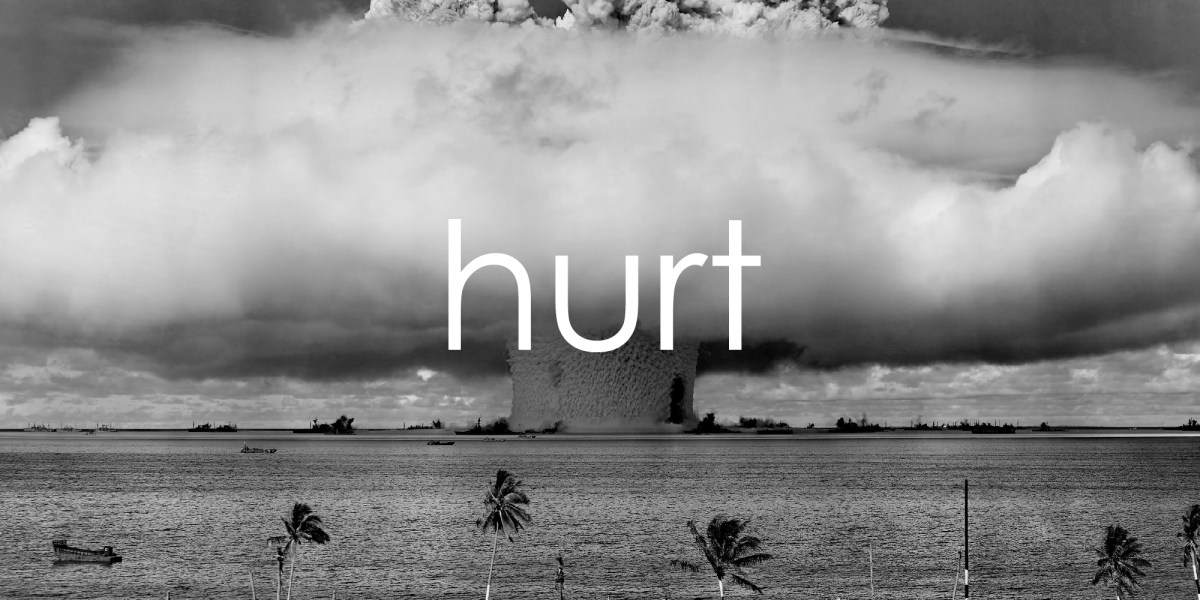
There is an eruptive quality to all of this; something almost atomic, which, of course, is the product of something small but central—nuclear—being fractured. And so it is that humans might behave like bombs, or is it the other way around? Continue reading “Hurt | #Friday500”

Balance | #Friday500

Used by permission. Michael Grab (gravityglue.com)A few months back I found myself suddenly beset by vertigo. It was an ordeal with which I would prefer no encore. At worst, the sensation was of constant spinning; an interminable Tilt-A-Whirl with a deranged operator. I could neither stand nor walk, but tottered and tipped my way through each day; bracing against anything and everthing firm. Even the menial required a Herculean effort of focus. Each slight sideways glance set my surroundings into nauseating slosh. By mid-afternoon, I was seasick and exhausted; incapacitated by nightfall. Accompanying these physical debilitations was the troubling uncertainty as to whether this would prove chronic or acute. Was this to become my new normal?

Mercifully, this condition waned and abated, leaving me with a newfound appreciation and awareness of this faculty called balance.

Balance, like many faculties, remains largely unheralded until it goes missing. We might learn to live in imbalance, as with other impairments, but only through compensating collateral exertion. Some cases of vertigo do in fact prove chronic, and the unremittingness of such a state unfamiliarizes those afflicted with experiential wellness while, at the same time, obscuring the toll exacted. We cannot comprehend what imbalance demands of us.

Haven’t so many of us forgotten what it means to be in balance? Continue reading “Balance | #Friday500”

Weight | #Friday500

The Hebrew word for glory is kabowd (כָּבוֹד), but its literal meaning is “weight” or “heaviness”. Of course, we humans are said to have been made for glory—for God’s glory. And this sounds so wonderful, but doesn’t it so often feel like weight—heaviness?

Adulthood catches most of us unawares. The scales suddenly tip; the stuff belonging to others surrenders to that which belongs to me. It’s weighty.

When we were children, clothing was purchased under the assumption of “growing into”; kneeling shoe store clerks prodding tips of Pro Wings, glancing up to indicate between thumb and index the allowance of space. It was silently ritualistic. Mom or dad or grandma nodding or wincing the verdict. Then, one unceremonious day, it stopped. Did the show fit or not? The starkness of that question sobered like cold water; it dizzied like a landed jab. And the adults, for their part, had made themselves scarce. Was this some prosaic right of passage? Yes. Continue reading “Weight | #Friday500”

depression

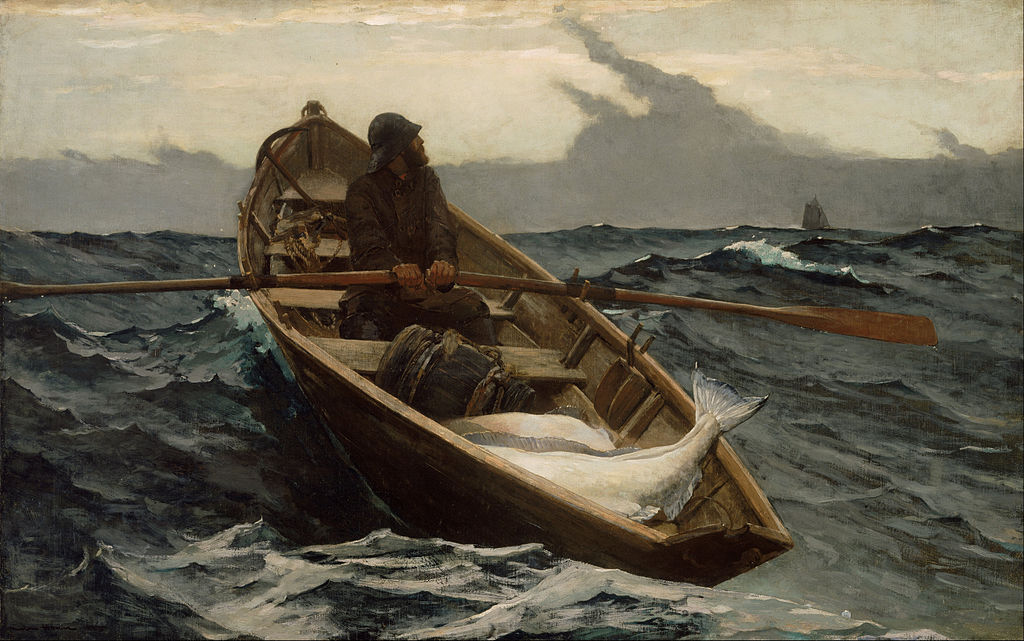
Fog Warning, Winslow Homer (1885)

Fog Warning is likely Winslow Homer’s finest piece. He produced it during a time of living and painting in the late 19th century off the coast of Maine. It tingles with a subtle drama. Portrayed is a solitary fisherman, his small row-boat, heavy with a catch of halibut, crests a wave. He is glancing over his shoulder at the main ship to which he must return. It is still a long ways off. In the distance, the fog is rolling in.

It may appear to be a somber depiction of New England fishing life, but it more dire than that. The 1876 volume The Fisheries of Glouscester records:

His frail boat rides like a shell upon the surface of the sea … a moment of carelessness or inattention, or a slight miscalculation, may cost him his life. And a greater foe than carelessness lies in wait for its prey. The stealthy fog enwraps him in its folds, blinds his vision, cuts off all marks to guide his course, and leaves him afloat in a measureless void.

This fisherman is facing real peril.

Homer keeps the scene unresolved. And I can’t help but see it as a portrayal of depression. Those of us who have experienced depression can relate to this solitary figure. The inner plea, “No. No. No.” Continue reading “depression”

The Human Paradox | #Friday500

On January 19, 2006 NASA launched the New Horizons probe at a departure velocity of 36,000 mph (10 miles per second!). For the next decade it would travel three-quarters of a million miles each day toward an object over 5 billion miles away, which was moving 10,000 mph in an irregular elliptical orbit around the sun—the planet Pluto. The probe whizzed by in July of 2015 and began taking high-resolution photographs of the planet. It needed to slip through a window of space about the size of Delaware, and had only 100 seconds to do so. It did so. It then began broadcasting the images back to earth; a transmission requiring over 16 months of travel until their earthly reception. In October of 2016 the stunning images began arriving.

As it turns out, Pluto bears the marking of a magnificent heart.

In the intervening years, it came to light that Bernard Maddoff had hoodwinked investigators while defrauding investors in his Ponzi scheme to the tune of $18 billion. Fortunes were lost. Lives were lost. Investment banks and bankers gorged themselves on the cannibalistic wealth-structures of mortgage backed securities, before nearly collapsing the American economy during the sub-prime mortage crisis; leaving tax-payers and underwater mortgage-holders shouldering the crushing load. An earthquake struck the impoverished nation of Haiti, and, as a result of sub-standard construction and lack of services, killed nearly 200,000 people. Between 2010 and 2012, almost 300,000 people (10% of children under 5 years of age) died because of famine in Somalia. Both catastrophes, among innumerable others, would have been fractional in scope if not for an unimaginable inequality produced by an unconscionable hoarding of global resources. During this decade, the richest 1% went from holding 40% to over 50% of our world’s wealth.

This is the human paradox. That humans are a species apart, this is undeniable. Yet what is also undeniable is that something is terribly wrong. A race that is capable of almost anything, tends overwhelmingly to utilize their incalculable powers for brutality over beauty. Unlike Pluto, we do not bear the markings of a magnificent heart. Continue reading “The Human Paradox | #Friday500”

Naming | #Friday500

I’ve recently discovered myself to be a fairly poor runner. I’m consistently inconsistent, and can scarcely muster 2 miles. I know. But on those rare and rough occasions when I strap on the sneakers, I always run past the above statue. Perched on a pedestal amidst a calmingly manicured wooded parcel, it gazes out over the “Midway Plaisance“—a stretch of green space that runs along the south section of the University of Chicago. It was originally a convention space for the 1893 World’s Fair; the site of the first ever ferris wheel.

Plaisance is a French word, which appropriately means, “pleasantness”.

It contains a cryptic plaque emblazoned only with “Linné”. During one such run, I determined to solve the mystery. I learned its likeness to be that of 18th century Swedish botanist, zoologist and physician Carl von Linné, considered the Father of Taxonomy; viz., naming organisms. He devised our modern binomial i.e. genus, species).

Linné wrote:

The closer we get to know the creatures around us, the clearer is the understanding we obtain of the chain of nature, and its harmony and system, according to which all things appear to have been created.

Naming is a uniquely human activity; a component of what evolutionary biologist have coined niche construction—the way organisms shape their environment. Naming is a form of ordering and understanding, and it carries a power we are prone to under-appreciate—the power of definition. Continue reading “Naming | #Friday500”

Revelation | #Friday500

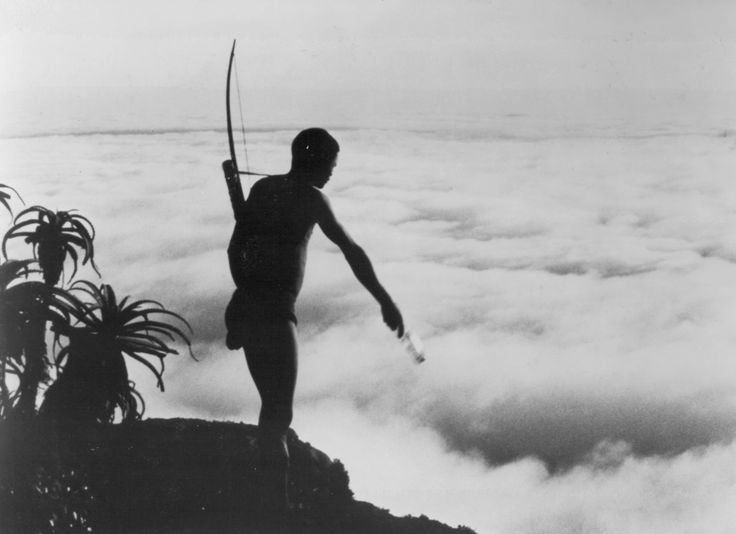
A favorite movie from my childhood was the 1981 South African film The Gods Must Be CrazyIt’s hysterical. It’s a rollicking story about an African bushman named Xi who is sent by his tribe to hurl a Coke bottle off the edge of the earth. The bottle had been dropped from an airplane, but they conclude, since it came from the sky, that it had been given by the gods.

It is like nothing they’ve ever seen, and can be used to do everything from milling grain to playing music. But there’s a problem. There is only one. Eventually it begins to divide the tribe—at one point being employed as a weapon.

So they decide that the gods have made a mistake in giving them this object, and Xi is sent on his mission, during which he encounters the civilized world in all of its absurdity. Hilarity ensues.

And the premise that the gods have given a gift we don’t fully know how to handle seems to parallel our conundrum with the Scriptures.

What are they really? Mostly stories, and fairly unresolved ones at that! If we receive them as they offers themselves to us—implicitly, explicitly and in their given form—we are presented with a Creator whose prefered method of self-disclosure is to involve himself in the lives of real people, then prompt them to record an account.

Almost every story leaves us perplexed, right? Sure we can sift out the troublesome bits, but isn’t that a troublesome thing to do? Isn’t that akin to saying, “the gods must have made a mistake”? Continue reading “Revelation | #Friday500”

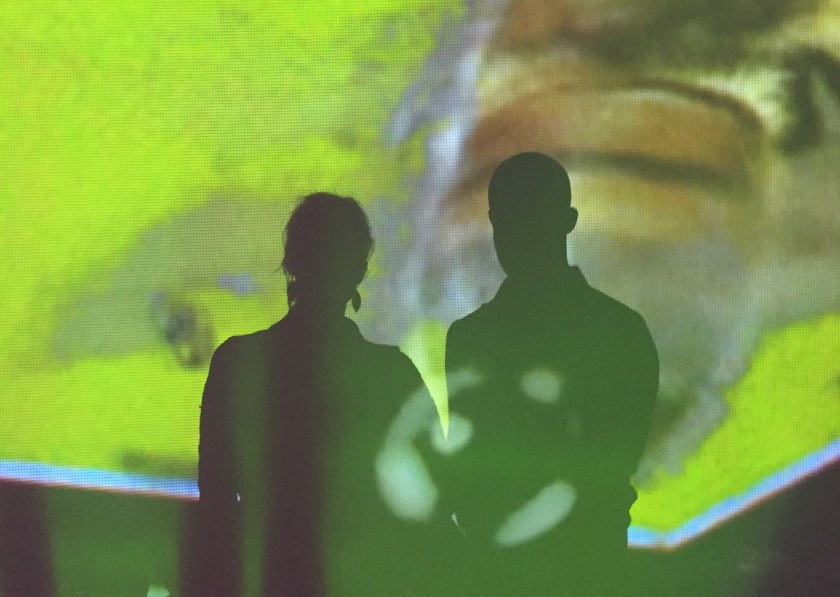
Waggle Dance (Diana Thater)

IMG_4867.JPG

Apiologists tell us that when a scout bee discovers pollen, it returns to the hive to do an elaborate dance. This dance is called the waggle dance. It’s purpose? To communicate to the rest of the hive where the food is located; especially if it is far away.

During the waggle dance, the scout runs in a straight line while waggling her abdomen, and then returns to the starting point by running in a curve to the left or right of the line. The straight line indicates the direction of the food in relation to the sun. If the bee runs straight up the hive wall, then the foragers can find the food by flying toward the sun. If she runs straight down the wall, then the foragers can find the food by flying away from the sun. As the dance progresses, the dancing bee adjusts the angle of the waggle run to match the movement of the sun. [1]

Isn’t that fascinating? They dance around the hive, and the others pay such close attention that they know where to find their sustenance. The hive survives on dancing!

Of course, I didn’t learn this from my apiology classes, but from an intriguing exhibit of American video-installment artist Diana Thater‘s work at The Museum of Contemporary Art in Chicago. (Free on Tuesdays!)

Overall her installment at MCA is really enjoyable and well executed. I found myself thinking about how interactive and playful it was; and that it felt well conceived and carried out.

It is called The Sympathetic ImaginationIt finds it’s genesis in a quote by the Nobel Prize winning South African novelist JM Coetzee:

There is no limit to the extent to which we can think ourselves into the being of another. There are no bounds to the sympathetic imagination.

Continue reading “Waggle Dance (Diana Thater)”

Honesty | #Friday500

In 1759 the French Enlightenment philosopher Voltaire published his satirical piece CandideIt tells the fantastical journeys of the simple Candide and his tutor Dr Pangloss. The saga commences when he is expelled from the idyllic Westphalia after being discovered in an innocent romantic liaison with the Baron’s daughter Cunegonde.

Candide is thrust out into a garishly tragicomic world of suffering armed only with the positivist ideas of Pangloss, with whom he is quickly reunited.

All is for the best, in the best of all possible worlds.

Voltaire was lampooning Gottfried Leibniz, the Christian mathematician-philosopher  whose Théodicée built a theological philosophy coining a similar phrasing. (Voltaire considered Leibniz to be a bit of a preening dabbler, and thus credentialed Pangloss a “professor of meta-physico-theologico-cosmolo-nigology”. That one got me!)

It’s a frolicking tale; one in which the obsolescence of Candide’s outlook must be reckoned with. It cannot hold up under the honest scrutiny of even the simplest, so he is forced to form a truer view of the world.

Honesty is a personal varietal of truth, is it not? But it is elusive because it is both objective and subjective simultaneously. (That you are anxious could be honest, but why? That’s a harder truth to name.)

Like Voltaire, we know optimism falls short of truth. But so too does pessimism. Flattery and gossip, cynicism and naiveté, histrionics and denial all evade, to quote Emily Dickinson, “all the truth.” We know this. We usually know when we’re being dishonest.

But the real problem is why. Continue reading “Honesty | #Friday500”