For Your Consideration (05/17/17)

usa-2148810

THE ECONOMICS OF IMMIGRATION

Xenophobic attitudes are becoming increasingly commonplace. They are at odds with so many things most of us would claim to value: patriotism, human dignity, unbiasedness, to name a few. It’s an unfortunate way to look out on the world.

But there’s more. Burlington, VT based freelance author Adam Bluestein wrote this well-reasoned piece for Inc. magazine back in 2015. He make a strong case for increasing portals for immigration (e.g. increasing the H-1B visa caps).

He shares some helpful examples of how immigrants have become the engine for business creation in our nation. And he also peppers in some helpful stats:

 From 1996 to 2011, the business startup rate of immigrants increased by more than 50 percent, while the native-born startup rate declined by 10 percent, to a 30-year low. Immigrants today are more than twice as likely to start a business as native-born citizens.

Despite accounting for only about 13 percent of the population, immigrants now start more than a quarter of new businesses in this country.

Xenophobia is bad for our national economic well-being.

I’m not always certain why such attitudes retain their power. They have haunted us throughout our nation’s history. “Remember when people thought the _______ were gonna ruin our way of life?” We think this so odd, and yet it cannot seem to be shaken.

I work extensively with first and second generation Americans on the college campus; the sheer tenacity it takes to uproot and rebuild one’s life in a foreign land guided only by the abstraction of “opportunity” couldn’t be a more American ideal. I find their stories endlessly fascinating, inspiring and hope-inducing.

Immigration laws and regulations are understandable and needed. But would that they weren’t laced through with such self-inflicting fear-based impulses.

Carbonite CEO Mohamad Ali wrote an OpEd for this week’s Harvard Business Review in this same vein. He shares the story of how his family arrived in the US after fleeing from Guyana in 1981 (which was when he first witnessed an escalator).

He notes:

Forty percent of Fortune 500 companies were founded by immigrants or the children of immigrants. Intel founder Andy Grove was a refugee from communist Hungary. Apple cofounder Steve Jobs is the son of Abdulfattah Jandali, an immigrant from Syria. Today, the trend continues. A recent study of billion-dollar startups found more than half were founded by immigrants. Our next generation of great companies, too, will depend on immigrants — as will the American economy as a whole.

He concludes:

In recent months, I’ve thought back many times to my own path to U.S. citizenship. Three decades after I looked up from the bottom of that escalator, I am contributing to the economy and creating jobs in a meaningful way. The American Dream is still alive, and it is core to innovation and competitiveness. But we must protect it.

Both articles are worth a read. The first is long. The second is short. For some clarity on the H-IB visa, here’s this.

So if xenophobia chafes against our purported values, and also our national interests (that is to say it is unpatriotic), what lies beneath such attitudes and behaviors?

ECONOMIC OR CULTURAL ANXIETY?

After the latest general election, it became widely accepted that economic anxieties were what explained Trump’s appeal among the white working class (the sub-segment which most decisively accounted for his victory).

And yet, as the ever perceptive Emma Green wrote in last week’s Atlantic, new evidence is showing that these voters’ anxieties were actually more culturally animated.

She sites the following,

Controlling for other demographic variables, three factors stood out as strong independent predictors of how white working-class people would vote. The first was anxiety about cultural change. Sixty-eight percent of white working-class voters said the American way of life needs to be protected from foreign influence. And nearly half agreed with the statement, “things have changed so much that I often feel like a stranger in my own country.”

And I think this is largely right (at least among this subset of voters, and also others). It is a jarring thing to feel like a stranger in one’s native land; so much so, that one can scarcely help one’s self from opposing those forces that are bringing this sensation about.

But, as with all fears, the real discord lurks beneath, and demands to be confronted. White America is reluctantly coming to terms with the deterioration of their American normativeness. It is unsettling, because the cultural habitat has always been of our own unknowing construction.

As with all fears, they tend to be fairly irrational. Oftentimes, we fear those things which stand to enhance us. Discomfort might be a sort of crucible.

Read Green’s short article. Or just watch this little summary video. Either way, let’s not let the fearful waters of the world around us fill our vessels to sinking. However that water got in there, it’s time to start bailing it out.

https://www.theatlantic.com/video/iframe/526566/

THE NEW COLOSSUS

I hate to admit that I’ve never read the entirety of Emma Lazarus‘ poem “The New Colossus” (you know the one, it’s lines appear on the plaque welcoming visitors to The Statue of Liberty).

But I’ll leave it for you here to read and enjoy!

Not like the brazen giant of Greek fame,
With conquering limbs astride from land to land;
Here at our sea-washed, sunset gates shall stand
A mighty woman with a torch, whose flame
Is the imprisoned lightning, and her name
Mother of Exiles. From her beacon-hand
Glows world-wide welcome; her mild eyes command
The air-bridged harbor that twin cities frame.
“Keep, ancient lands, your storied pomp!” cries she
With silent lips. “Give me your tired, your poor,
Your huddled masses yearning to breathe free,
The wretched refuse of your teeming shore.
Send these, the homeless, tempest-tost to me,
I lift my lamp beside the golden door!”

SOCIAL CURATE

A guy draws a cartoon of himself, and invites the internet to be his bud. The rest?

For Your Consideration (05/10/17)

sculpture-2209152.jpgDEMOCRATIC STORYTELLING (THE ATLANTIC)
Kawandeep Virdee contributed a very short piece for this week’s Atlantic suggesting that stories play an ever needed role in our democracy.

It wasn’t actually a wonderful piece. (It was a bit aimless.) But… buuut… I did agree with his overall premise. Stories humanize, whereas most political mediums for engagement polarize by reducing groups to faceless, wrong masses.

He writes of the latest general election:

The walls between points of view thickened. There now seem to be multiple realities, each with media outlets to support them with fragments of a story instead of the full picture. Because of this divisiveness, people cannot understand each other, and even choose to ignore each other.

I think this is true. And I enjoy voices who realize that the question needs to shift from “Who’s right?” to “Where did the conversation break down?”

He goes on:

Stories can be personal, and convey vulnerability. They can also cultivate empathy to thin the wall between dissonant points of view. While most of the stories may not resonate across different opposing views, even just a few can start building bridges of understanding.

I’m all for thinning walls between dissonant points of view. Our nation could stand to learn some lessons from cheap hotels, eh?

Stories are indeed powerful forces for empathy and understanding.

EVERY OTHER HOUR (WBEZ)

In light of the power of story, I’m really proud of my local NPR station (that’d be WBEZ Chicago) for this bold and timely initiative. It is a year-long effort exploring the question of “Who picks up a gun, and why?”

They explain:

For more than a year now, there’s been a person shot about every other hour. That relentless violence has ended hundreds of lives and damaged thousands more. It’s changing the life of the city.

Chicago has woven in and out of the news cycle as a placeholder for urban violence. Most references are downright lazy or uncharitable. But it is indeed a complex and dire issue in our city. If we can’t begin to grapple with the human realities at play, we’re only working with broad abstractions.

To better understand who picks up a gun and why, WBEZ will offer stories and conversations designed to break through entrenched assumptions and shape the conversation around gun violence in Chicago.

What’s cool is that they have provided audio for each piece. Listen while you travel!

I just get a warm feeling inside me when I think of this great station taking up this project, and I plan to keep checking back in. Maybe we should give to support this station? Where do you go to do this?

TEBOW & KAEPERNICK

Sydney, AU based missiologist, professor and author Mike Frost offers a reflection on the reception of two Christian figures (“A Tale of Two Christianities on Its Knees“).

Why does our nation throng to Tebow and root him on, while abandoning Kaeperkick, en masse? Frost simply anguishes over the needless dividedness this reveals in American Christianity. Division between two sides who need one another a great deal:

You can see where this is going. The bifurcation of contemporary Christianity into two distinct branches is leaving the church all the poorer, with each side needing to be enriched by the biblical vision of the other.

Biblical Christianity should be, as Walter Brueggemann expresses it, “awed to heaven, rooted in earth.” We should, as he says, be able to both “join the angels in praise, and keep our feet in time and place.”

Sadly, with the suspicion and animosity shown toward each side of the divide by the other I can’t see a coming together any time soon.

I’m with you, Mike.

I think everyone should read this, if for no other reason than to hear an achingly sympathetic account of Colin Kaepernick. He deserves more of this.

SOCIAL CURATE

There needs to be a term to describe the art represented by those exploring digital mediums of creative-interface. There are a bunch out there. I’m always tickled by Rich McCor (@paperboyo) and his paper cut-out overlays from around the world.

Evidently there’s a documentary piece being made about him. (Watch the video below, where you hear some thoughts on art and medium.)

I would recommend a scroll through his Instagram, and, obviously, giving him a follow.

For Your Consideration (05/03/17)

IMG_5754.PNG

ROBOT PROOF YOURSELF!

This playful piece from Inc. argues that the key to making yourself irrobotically replaceable (that’s a thing!) is by striving to be more human!

Author Tim Leberecht asserts,

If you’re not worried about AI and the future of your job, then you’re not human. So stop right there: Being more human is exactly what will save us from the robots.

He gives a few specific thoughts (ending by lauding the liberal arts, s/o).

Here’s a gem, though:

…soft skills are the hard skills of the future. Feeling is the new thinking. With everything that can be done efficiently soon delegated to machines, only what is inherently human will help you retain your competitive advantage in the job market.

While artificial intelligence can replace any skill that’s routine or extremely complex, AI can’t replace social skills such as persuasion, empathy, character, or teaching.

True, or no, I love this sentiment: soft is the new hard and feeling is the new thinking! (I actually know it’s true!)

Speaking of being more human…

MEANINGFUL WORK (NOT JUST FOR ELITES)

I spend hours each week in my work championing the notion that all humans are made for meaningful work. Those who do not have it within reach experience its phantom lacking. Those who do, often feel a cognitive dissonance of guilt toward their privileged state.

For my part, I consider the meaningfulness of our work as part privilege part social remedy and thus of sacred importance.

To quote Frederick Buechner:

Vocation is the place where our deep gladness meets the world’s deep need.

For this reason, I was drawn to this article at Harvard Business Review by Richard Straub and Julia Kirby arguing that “Meaningful Work Should Not Be a Privilege of the Elite.”

They give consideration to several measures of societal prosperity, one of which posits, “Prosperity in a society is the accumulation of solutions to human problems.”

They take it a democratizing step further, and I resonate with their insight:

 If we’re thinking about prosperity in broad terms, then we should also recognize it isn’t just the solutions themselves that improve quality of life – it’s also engagement in the act of solving. Participating in the satisfying work of innovating enriches lives by endowing them with purpose, dignity, and the sheer joy of making progress in challenging endeavors. Imaginative problem-solving is part of human nature. Participating in it is essential to the good life – and no elite minority should have a monopoly on that.

The whole article is a worthwhile read, if for no other reason than to give consideration to how societal prosperity and meaningful work can be defined. It also can be a prompt to consider whether (or how) your life might be “engaged in the satisfying work of solving our societies problem.”

It’s an idea that cuts two humanizing ways: aspire to your highest meaning by helping others in your society to do the same.

HOW TO REMEMBER THE CIVIL WAR

Of course this topic flubbed its way clumsily into the national conversation this week. (Cue the sad fiddle music!) But last week’s Economist tells the story of a “cyclorama” (a 360º enclosed panorama), which was initially created to celebrate the Union victory in the Battle of Atlanta. (You’ll recall Gone With the Wind? It even features Rhett Butler.)

After being moved to be displayed in the south, the soldiers uniform colors were altered to recast the piece as a memorial to the Confederate cause!

In line with the region’s mythology, which even today can make it seem that the South won every battle but lost on a technicality, advertisements declared it the “Only Confederate Victory ever Painted.”

It eventually fell into disrepair and was confined to storage. It is now being re-restored, but elicits the question of what angle it will present.

The exhibition will present it not as a shrine but as a palimpsest, as full of meaning as it is of bloodshed, with explanations not only of the battle but of the painting’s own past—including the long stretch in which white and black viewing hours were segregated.

Our nation’s history is complicated to put it lightly, thus we must find imaginative and truthful ways of remembering it! For this reason, I appreciated this case study.

Also, palimpsest? What a great word! Cyclorama? Impresario? If the Economist only provided bylines, I would tweet the author to compliment his or her vocabulary—but, alas!

MILKY WAY VIA COCKPIT

An airline pilot named Sales Wick shot this spellbinding time-lapse of the Milky Way from the cockpit during a flight from Zurich to Sao Paulo. This was featured on Gizmodo’s Sploid site.

Not much more to say. How else might you spend the next 3 minutes?


CURRATED TWEET

I may try to add a curated tweet each week.

Here’s one:

Racism II: Defined | #Friday500

[This is post is part of a five-part series. You can find a link to all five here.]

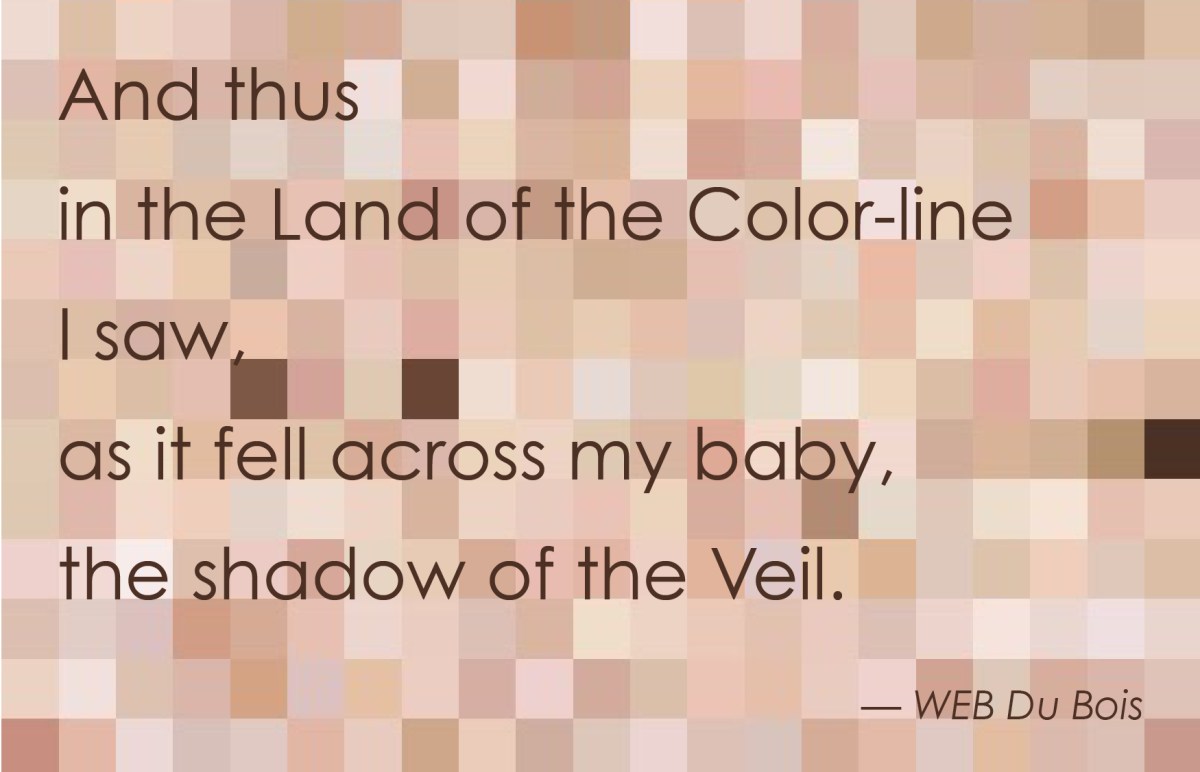
Let’s just cut to the chase, shall we? Whites mean something different than non-whites when they use the term “racism.” This effectively stalls one of the most needed of national conversations on the topic of race, because our semantics on the pivotal word are incongruent.

I’m going to use the terms “white” and “non-white” in a broad sort of way here. Firstly, I really mean most whites (the generality of the white community) and most non-whites. Secondly, blacks and indigenous Americans have the most direct and tragic history with the concept of race and racism in our nation, but the carryover onto every community of color has been enfolded into our nation’s cruelest legacy.

And while a mutually-understood employment of the term “racism” is critical toward any meaningful dialogue, it must be said up front: whites are wrong on this, and non-whites are right. Continue reading “Racism II: Defined | #Friday500”

For Your Consideration (04/26/17)

JaneAddams

THE JANE ADDAMS MODEL (DAVID BROOKS)

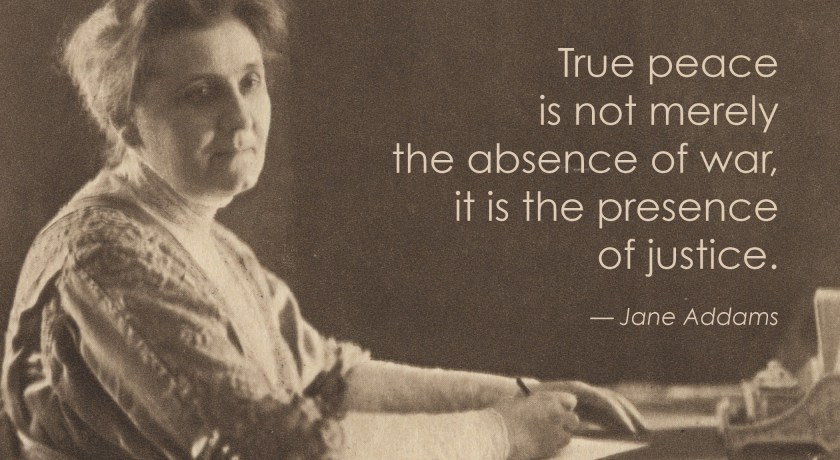
I would recommend David Brooks’  column in this week’s the New York Times lauding social work pioneer Jane Addams and holding her up as a paragon for our modern world.

Jane Addams was a forerunner of social work and social welfare. In response to the abject plight of immigrants in the near north neighborhoods of Chicago, she began what would become an extensive, city-wide network of centers. But it began with a work based out of her own home, which came to be known as The Hull-House.

Brooks describes a trip to Europe that inspired her vision:

In London, she visited a place called Toynbee Hall, a settlement house where rich university men organized social gatherings with the poor in the same way they would organize them with one another. Addams returned to Chicago and set up Hull House, an American version of the settlement idea.

I walk past the Jane Addams Hull-House Museum at Halsted and Polk on the UIC campus many times each week, and was piqued to see Brook’s feature of Addams’ work there.

Her ability to constantly merge philosophy with action, and vice versa, was one of her defining qualities. Her aspiration was to kindle the dignity of those with whom she worked.

There were classes in acting, weaving, carpentry, but especially in art history, philosophy, and music. Addams was convinced that everyone longs for beauty and knowledge. Everyone longs to serve some high ideal. She believed in character before intellect, that spiritual support is as important as material support. And yet “the soul of man in the commercial and industrial struggle is under siege.”

I love the notion of fighting against the siege on the souls of men, and appreciate her human dignity-lifting ideals.

Her work would become a global model for how to work among the poor and disenfranchised, and I agree with Brooks that hers remains an important model for our world.

SEE YOURSELF IN OTHERS (TRIBECA FILM FEST)

The Tribeca Film Festival released a short film called “See Yourself in Others”. They involved people from many walks of life, and sent them onto the streets of New York with a five-sided mirror helmet (one which allowed passers-by to see their own reflections atop the body of the wearer, but also allowed the wearer to observe their responses).

It is meant as a provocative celebration of empathy. Curbed NY ran a feature on the piece, which was created in conjunction with DDB New York:

In a statement, Icaro Doria, the chief creative officer of DDB New York (which conceptualized the film along with Tribeca), said that “Stories put us in unfamiliar or uncomfortable situations and force us to confront other points of view.… More than ever, we need these stories and we need this empathy. Because we need each other.”

Initiatives like this only accomplish so much, but any effort to inject empathy into our nation’s bloodstream is welcome.

This resembles the message of my values post:

Currency exchange is probably a fitting allegory we might adopt. The shapes, sizes and hues of values all have their basis and environ of worth. Values are foreign currencies, but currency nonetheless. Would we learn their purchase by going abroad from our insular worlds in whatever ways we might?

RESOURCES ON RACE & RACISM

I intend to follow up my recent post on racism and race with 2-3 more, but, in the meantime, I wanted to recommend a few resources that might help expand on my thinking for those of you who are interested.

On Friday, I offered the following:

We need to be having an important national conversation about race, but the incongruence of our vocabularies render this virtually impossible.

As with all conversations, meaning is irreducibly critical. When meaning is not mutually shared or at least understood, dialogue will always degenerate.

Whites and non-whites mean different things by the word racism, and until this gets more broadly sorted out communication on the topic is fraught with discord.

  • THE LITURGIST PODCAST (BLACK & WHITE: RACISM IN AMERICA) – Hosts Michael Gungor and Science Mike welcome rapper and Propaganda and musician William Matthews on their show to have a fairly elucidating conversation about race and racism in America and in the American church. Pretty pointed.
  • WASHINGTON POST (1992) – As I began my initial search for resources on this topic, I was amazed at how few media outlets were addressing the obvious semantic incongruence between whites and blacks regarding the meaning of the word “racism”. The only article I found that was addressing it head on came from a post-Rodney King verdict article in the Washington Post—in 1992! Isn’t that insane! Here it is.
  • RACE: THE POWER OF AN ILLUSION (PBS) – Back in 2003 (14 years ago), PBS release a 3 part series on race and racism called “Race: the Power of an Illusion”. It feels dated, but it is one of the better options out there for understanding the topic of race. I can’t find episodes 2 and 3, but here’s the first installment. It’s about 1 hour long.
  • VOX (THE MYTH OF RACE DEBUNKED) – If you don’t have an hour, here is a brief video released by the site VOX on the topic. It’s 3 minutes, so pardon the overweening promise. Also, pardon the pretty weak narration. It isn’t always a good idea to have the author do the reading (IMO).  It is a good primer, though. Here’s the video:


Let America Be America Again (Langston Hughes)

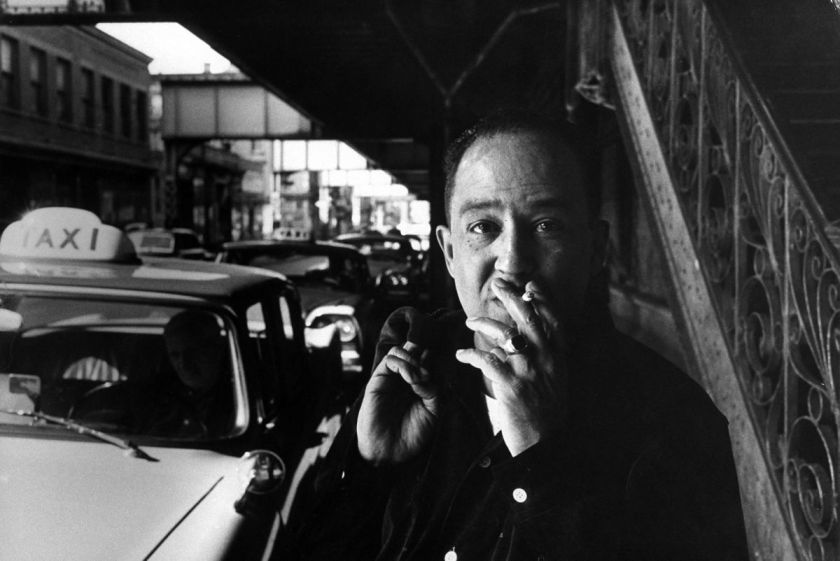
LangstonHughes

In October of 1859, the abolitionist John Brown led a band of 22 men on a raid of Harper’s Ferry, Virginia (now WV). There was a government arsenal housed there, and Brown had hoped to arm slaves and abolitionists in a sweeping battle of southern slave liberation.

They succeeded in seizing the town, but were quickly pinned down and suppressed by Marines under the command of Robert E. Lee.

Brown was arrested, and, several weeks later, hanged for treason. His life was a spectral portent of our nation’s imminent collapse into civil conflict and prompted Henry David Thoreau to pen the following:

Some eighteen hundred years ago Christ was crucified; this morning, perchance, Captain Brown was hung. These are the two ends of a chain which is not without its links. He is not Old Brown any longer; he is an angel of light.

The poem, “John Brown’s Body” became a Union marching hymn.

A free black man named Lewis Sheridan Leary was one of the men who lost their life under Brown’s command during the ill-fated raid. His widow Mary would later remarry Charles Langston. Their daughter Caroline would then have a son, and he would receive her maiden name as one of his two middle names. His full name was James Mercer Langston Hughes. The world would know him as the famed Harlem Renaissance poet Langston Hughes.

Hughes was born in Joplin, MO, but lived most of his childhood in Lawrence, KS. In early adulthood he lived everywhere: Mexico, France, England, Chicago. He died in New York City in 1967 at the age of 65.

He was a proponent of the embrace of black identity and of a clear eyed view of our complicated national story.

Nowhere is the latter more ringing than in his poem, “Let America Be America Again.” I think you’ll find its theme very timely; both searching and amazingly resilient its longings.

Here it is.

Let America Be America Again

by Langston Hughes

Let America be America again.
Let it be the dream it used to be.
Let it be the pioneer on the plain
Seeking a home where he himself is free.

(America never was America to me.)

Let America be the dream the dreamers dreamed—
Let it be that great strong land of love
Where never kings connive nor tyrants scheme
That any man be crushed by one above.

(It never was America to me.)

O, let my land be a land where Liberty
Is crowned with no false patriotic wreath,
But opportunity is real, and life is free,
Equality is in the air we breathe.

(There’s never been equality for me,
Nor freedom in this “homeland of the free.”)

Say, who are you that mumbles in the dark?
And who are you that draws your veil across the stars?

I am the poor white, fooled and pushed apart,
I am the Negro bearing slavery’s scars.
I am the red man driven from the land,
I am the immigrant clutching the hope I seek—
And finding only the same old stupid plan
Of dog eat dog, of mighty crush the weak.

I am the young man, full of strength and hope,
Tangled in that ancient endless chain
Of profit, power, gain, of grab the land!
Of grab the gold! Of grab the ways of satisfying need!
Of work the men! Of take the pay!
Of owning everything for one’s own greed!

I am the farmer, bondsman to the soil.
I am the worker sold to the machine.
I am the Negro, servant to you all.
I am the people, humble, hungry, mean—
Hungry yet today despite the dream.
Beaten yet today—O, Pioneers!
I am the man who never got ahead,
The poorest worker bartered through the years.

Yet I’m the one who dreamt our basic dream
In the Old World while still a serf of kings,
Who dreamt a dream so strong, so brave, so true,
That even yet its mighty daring sings
In every brick and stone, in every furrow turned
That’s made America the land it has become.
O, I’m the man who sailed those early seas
In search of what I meant to be my home—
For I’m the one who left dark Ireland’s shore,
And Poland’s plain, and England’s grassy lea,
And torn from Black Africa’s strand I came
To build a “homeland of the free.”

The free?

Who said the free? Not me?
Surely not me? The millions on relief today?
The millions shot down when we strike?
The millions who have nothing for our pay?
For all the dreams we’ve dreamed
And all the songs we’ve sung
And all the hopes we’ve held
And all the flags we’ve hung,
The millions who have nothing for our pay—
Except the dream that’s almost dead today.

O, let America be America again—
The land that never has been yet—
And yet must be—the land where every man is free.
The land that’s mine—the poor man’s, Indian’s, Negro’s, ME—
Who made America,
Whose sweat and blood, whose faith and pain,
Whose hand at the foundry, whose plow in the rain,
Must bring back our mighty dream again.

Sure, call me any ugly name you choose—
The steel of freedom does not stain.
From those who live like leeches on the people’s lives,
We must take back our land again,
America!

O, yes,
I say it plain,
America never was America to me,
And yet I swear this oath—
America will be!

Out of the rack and ruin of our gangster death,
The rape and rot of graft, and stealth, and lies,
We, the people, must redeem
The land, the mines, the plants, the rivers.
The mountains and the endless plain—
All, all the stretch of these great green states—
And make America again!

Racism I: Race | #Friday500

[This is post is part of a five-part series. You can find a link to all five here.]

There’s a very important but under-talked-about topic in our country, and it has to do with vocabulary of race and racism. Specifically, the incongruence between the usage and understanding of these terms between most white and non-white communities.

We need to be having an important national conversation about race, but the incongruence of our vocabularies render this virtually impossible.

As with all conversations, meaning is irreducibly critical. When meaning is not mutually shared or at least understood, dialogue will always degenerate.

Whites and non-whites mean different things by the word racism, and until this gets more broadly sorted out communication on the topic is fraught with discord. This crops up so often in main stream media and everyday conversations, that I can’t believe it isn’t constantly being clarified! It’s one of the least addressed semantic landmines out there.

Flannery O’Conner once said:

I write because I don’t know what I think until I read what I say.

I’ve tried to be pretty forthright that the things I’ve been posting are, in part, my own efforts to write in such a way as to “know what I think.” This topic may be the truest example of this, because, full disclosure, I myself had no awareness of this semantic incongruity until very recently.

My working definition of racism has always resembled this: Treating people differently based on their race.

This is the way whites commonly define racism: personal or situational incidents in which race becomes a criteria for our treatment—positive or negative—of others.

This is patently not the way a non-white would encapsulate the idea of racism.

But we can’t move this forward until we understand the term “race”.  Continue reading “Racism I: Race | #Friday500”

For Your Consideration (04/19/17)

SEXISM IN SILICON VALLEY (THE ATLANTIC)

I was traveling on the day I published my Billy Graham Rule post and grabbed the latest copy of The Atlantic (I consider it to be one of the last great magazines). I was intrigued to see the cover issue addressing a related issue, posing the question, “Why is Silicon Valley so Awful to Women?” by Liza Mundy.

For such a liberal and forward oriented industry, it would seem that tech is still very inhospitable to women. How so?

Susan Wu, an entrepreneur and investor, says that when she was teaching herself to code as a teenager, she was too naive to perceive the sexism of internet culture.

But as she advanced in her career and moved into investing and big-money venture capitalism, she came to see the elaborate jiu-jitsu it takes for a woman to hold her own.

At one party, the founder of a start-up told Wu she’d need to spend “intimate time” with him to get in on his deal. An angel investor leading a different deal told her something similar. She became a master of warm, but firm, self-extrication.

How ugly is this? What a backward set of skills we expect of such talented women!

The article goes on,

A report by the Center for Talent Innovation found that when women drop out of tech, it’s usually not for family reasons. Nor do they drop out because they dislike the work—to the contrary, they enjoy it and in many cases take new jobs in sectors where they can use their technical skills. Rather, the report concludes that “workplace conditions, a lack of access to key creative roles, and a sense of feeling stalled in one’s career” are the main reasons women leave. “Undermining behavior from managers” is a major factor.

Our nation is fumbling through many things right now, but degradation of women is certainly one of the items at the forefront.

The battle of the sexes is a human issue immemorial. It’s so morbidly fascinating that even in such a modern and liberalized setting as Silicon Valley, men are still so prone to devolution, isn’t it? Continue reading “For Your Consideration (04/19/17)”

Sport as Signal

On April 15, 1947 Jackie Robinson played his first Major League game. He started at first base and batted second in the lineup. He scored the winning run that day, but that was only a sheen on what he’d truly achieved; what was being achieved through this 28-year-old man.

Robinson was the first black player permitted to play in the modern Major Leagues.

That was only 70 year ago. Many who were there still live to tell about it.

I really love sports. And I’m always interrogating myself as to what that means—whether it’s a good thing or bad. Sports is really only entertainment, yet it occupies a special cultural space in societies far and wide. It can be an amniocentesis of culture and of the composition of societal values. In this regard, it must be seen as far more than mere entertainment. Continue reading “Sport as Signal”

Values | #Friday500

I’ve been thinking a lot about the topic of values since the last election, and the role they play in our national social, cultural, political conversation.

My teenage years were spent in Colorado Springs, during the 1990s high-momentum days of the Religious Right. Focus on the Family had just relocated to my town, Promise Keepers was filling more and more stadiums with fervent Christian men and tensions over values were palpable. I attended a Promise Keepers event in Boulder, Colorado in 1994, where planes flew over-head trailing scornful messages behind: “Smart Women Don’t Believe Your Promises!” read one; “Promise Keepers: Losers Weepers” another. Local residents would honk their horns and flash the finger while we walked back to our cars. I was just happy to be one of the good guys!

Nixon’s “silent majority” had morphed into Falwell’s Moral Majority, and now James Dobson & Co. were stepping in the ring—the gloves were coming off for those with values!

Of course this only galvanized those on the left to plant their own flag in the territory of values, and I recall the many Volvos and VWs tooling about town with bumper stickers like “Focus on Your Own Damn Family” ($1.50 on Amazon) and “Hate is Note a Family Value”. (There’s a sociology term paper titled “On Liberal Messaging” tucked in here somewhere.)

The decay of the nuclear family was bemoaned as our primary national ill. Then someone named Hillary Clinton wrote a book called It Takes a Villageand conservatives went apoplectic, “Don’t you dare!”

The idea of values had been beat from plowshare into sword, and was being swung with wild frenzy!

Even the Addams Family took up the cause! Things were getting weird.

Our nation became one big stadium chanting, “We’ve got values, yes we do! We’ve got values, how ’bout you?” back and forth.

It all died down eventually—or at least the term “values” got stretched indistinguishably shapeless—but the attitude had merely gone subterranean, like one of those giant worms from Tremors (among the finest of Reba McEntire films). And yet it surfaces still; hungry for more.

So lets settle this once for all: who has values? Continue reading “Values | #Friday500”